![[slide:title]](/static/upload/other/20260512/1778551853592214.webp)
![[slide:title]](/static/upload/other/20260512/1778551954982306.webp)
Time:2026-10-08 Form:本站
Within modern clinical dental implantology, the implant fixture determines osseointegration success, while the restorative component system directly governs long-term prosthetic outcomes, occlusal comfort, soft tissue contour and overall treatment stability. Many large chain clinics and dental distributors hold a persistent misconception: components can be interchangeably replaced as long as the implant brand remains consistent. In real clinical practice, however, platform matching, taper seating, anti-rotation structure, soft tissue height and occlusal load-bearing grade of restorative components all directly alter the final performance of the prosthesis.
With the widespread adoption of multi-system implant use, digital intraoral scanning, increasing immediate-load cases and higher aesthetic restoration requirements, restorative components are no longer simple supporting consumables. Instead, they form a core component of refined clinical treatment. For large clinics, component selection directly impacts rework rates and patient satisfaction. For distributors, the completeness of the component portfolio and precision of clinical compatibility directly control end-customer retention. This article deeply unpacks core procurement considerations for restorative components from brand-new perspectives: clinical compatibility logic, restorative tiered selection, multi-system compatibility implementation, digital supporting systems, long-term treatment stability and commercial inventory strategy, with zero overlap with previous articles.
Dental implant restoration follows a “two-layer structural system”: the basal layer relies on osseointegration of the intraosseous implant fixture, while the upper layer forms the soft tissue and occlusal system comprising abutments, screws and prostheses. Unlike the bony stability achieved during surgical implantation, restorative components operate long-term within a moist, force-bearing, micro-moving and bacteria-prone oral environment, demanding extremely high standards for structural marginal adaptation, surface treatment and mechanical balance.
Three mainstream structures are adopted across different implant systems: platform-switching, platform-matching and taper-locking. Each corresponds to distinct abutment marginal diameter, shoulder height and soft tissue cuff. Mismatched component platforms lead to marginal overhang, poor gingival adaptation, food impaction and plaque accumulation. Over time, these trigger chronic gingivitis, soft tissue recession, eventually resulting in black triangles and marginal bone loss, severely compromising aesthetic outcomes and long-term stability.
Anti-rotational slot positioning is mandatory for anterior aesthetic restorations and single-unit independent restorations to prevent crown rotation and displacement. Many universal components feature simplified anti-rotation structures. Although they can be screwed in superficially, precise positioning cannot be achieved, resulting in crown misalignment, occlusal prematurities and poor proximal contacts — a major source of hidden clinic rework. For fixed bridges and splinted multi-unit crowns, non-rotational abutments may be used, yet higher requirements for concentricity, verticality and marginal gap are enforced.
Occlusal pressure in posterior regions far exceeds that of anterior areas, requiring rigid abutments, reinforced bases and high-strength locking screws. Most universal components adopt uniform thickness and strength without differentiation between high- and low-stress zones. Long-term posterior loading may induce screw fatigue, micro-loosening and abutment deformation, leading to long-term prosthetic failure.
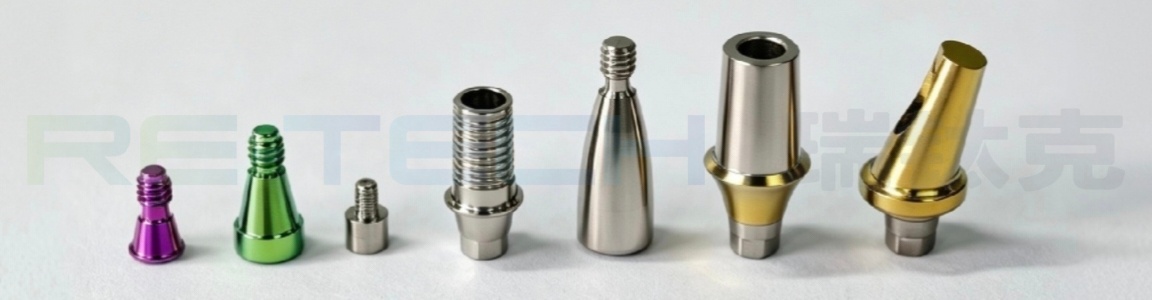
A mature restorative component system is not a random collection of SKUs. It forms a complete tiered portfolio covering healing restoration, provisional restoration, definitive restoration, digital restoration and high-load restoration. Large clinics utilise tiered selection to cover all case types, while distributors build professional differentiation through tiered product layout — a professional barrier that generic commodity components cannot replicate.
Healing & Contouring Tier: For soft tissue aesthetic shaping Includes straight, curved, narrow-neck and wide-neck healing abutments compatible with varying gingival thickness, sulcus depth and soft tissue elasticity. High-quality healing abutments gently displace gingiva to form well-defined cuffs, avoiding postoperative gingival collapse, hyperplasia and asymmetry, laying an aesthetic foundation for final crown restoration. Aesthetic discrepancies observed in many premium anterior cases essentially stem from differences in soft tissue contouring during the healing phase.
Provisional Restoration Tier: For occlusal transition and soft tissue adaptation Provisional abutments and provisional restorative components are mainly applied for immediate and transitional restorations, undertaking short-term occlusion, guiding soft tissue adaptation and maintaining spatial positioning of teeth. Provisional components do not require ultra-high rigidity, yet strict standards for surface finish, marginal adaptation and contour profile are required to prevent inflammatory irritation and gingival hyperplasia during the provisional stage.
Definitive Restoration Tier: Core Mainstay for Clinical PracticeDefinitive abutments, locking screws and angled-correction bridge abutments constitute the core supporting system for long-term clinical performance. Components within this tier must deliver zero-gap interface fit, mechanical balance and strong anti-fatigue properties to withstand years of masticatory vibration, temperature fluctuation and corrosive moist oral conditions, ensuring over 10 years of stable prosthesis survival.
Digital Restoration Tier: Compatible with Fully Digital Clinical WorkflowsDigital scan bodies, digital implant analogues and CAD/CAM abutment blanks are critical links across intraoral scanning, design, milling and chairside restoration. Parameter deviations in digital components directly cause distorted model data, ill-fitting milled crowns and excessive marginal gaps — a precision-critical category that digital clinics must rigorously control.
Most large clinics today operate three, four or even more implant systems concurrently, with legacy, mainstream and newly launched systems overlapping. The traditional procurement model of brand-exclusive components suffers low efficiency, while purely universal components lack precision. A scientific multi-system compatibility framework is therefore required.
Many implant brands slightly adjust taper angle, locking slot depth, platform diameter and thread pitch during product iteration. Though visually nearly identical, their components are non-interchangeable. Fitting new-version components onto old fixtures leads to incomplete locking; mounting old components on new fixtures creates positional play and micromovement. Large clinics should maintain version ledgers, categorised by year, batch and interface type, to prevent clinical misuse.
Numerous external hex, internal hex and taper interfaces appear similar on the market. However, tolerance systems, taper ratios and limiting heights vary widely between brands. Forcing interchange creates micron-scale gaps. Asymptomatic in the short term, these gaps lead to persistent bacterial leakage, bone resorption and screw loosening over time, the root cause of chronic prosthetic failure.
Genuine professional multi-system compatible components are not built on universal unified parameters. Instead, they independently replicate original manufacturer specifications for each brand, model and release version, enabling precise matching by system, model and year. Taking the RE-TECH component portfolio as an example, its independent drawing library, version database and digital parameter library support coexistence of multiple systems without mutual interference, perfectly meeting complex case demands of large clinics.
Conventional procurement prioritises price and stock availability. Professional tiered procurement evaluates portfolio completeness, clinical adaptability, long-term stability and digital compatibility. The difference directly determines clinical quality in clinics and product competitiveness for distributors.
| Procurement Dimension | Traditional Universal Component Procurement | Clinical Tiered Professional Procurement |
| Product Logic | Unified universal specifications, no differentiation by system or version | Tiered, classified by system, version and load grade |
| Clinical Adaptability | Only suitable for basic legacy systems; poor compatibility for new releases | Full coverage of old and new systems; suitable for complex and aesthetic cases |
| Soft Tissue Performance | Moderate cuff adaptation; prone to food impaction and recurring inflammation | Precise contouring, superior soft tissue sealing, stable aesthetic results |
| Occlusal Load Performance | Uniform strength; prone to fatigue and loosening under high posterior load | Separated high/low stress design; high-strength posterior support, fine anterior aesthetic adaptation |
| Digital Compatibility | Lack of precise digital parameters; large intraoral scanning error | Complete supporting digital database, compatible with full digital restoration workflows |
| Long-Term Rework Rate | Relatively high; numerous long-term complications | Very low; stable marginal adaptation, well-maintained bone level |
Procurement logic for large chain clinics differs greatly from standalone practices. The core goal is not cost reduction, but standardisation, consistency, low rework rates and replicable treatment.
A common issue across multi-location chains is mixed component brands and inconsistent standards between branches, leading to variable clinician handling experience, inconsistent prosthetic outcomes and uneven rework rates. Adopting a unified tiered component system standardises restorative workflows and homogenises treatment results across all sites, greatly elevating the brand’s professional profile.
Anterior aesthetic cases, high-load posterior cases, immediate-load restorations and conventional treatments consume components at different rates. Large clinics can dynamically adjust inventory ratios for healing, provisional, definitive and digital components based on internal case statistics, avoiding stockouts of fast-moving items and overstock of niche SKUs.
Full digitalisation of dental implantology is inevitable. Clinics must source components aligned with parameter systems of intraoral scanners, design software and milling equipment. A complete digital component ecosystem shortens restoration cycles, reduces lab errors and improves fabrication accuracy, forming the core hardware foundation for chain clinic upgrades.

To escape low-price competition, dental distributors must compete not on pricing, but on product professionalism, full clinical compatibility and technical supporting capacity.
Cover the five tiers: healing, provisional, definitive, high-load and digital restorations. Enable end clinics to purchase full-process restorative components from one source instead of sourcing from multiple suppliers. A comprehensive product portfolio is the core barrier to locking in key accounts and boosting customer stickiness.
The biggest weakness of generic market components is undifferentiated versions and ambiguous compatibility. Distributors focusing on precise version matching and full multi-system coverage with clinically validated low rework rates can quickly differentiate themselves from low-cost commodity suppliers and build a high-end professional channel image.
Beyond products, supply compatibility manuals, version comparison tables, digital databases and clinical selection guidance. Clients obtain not merely products, but a mature clinical restorative solution, substantially improving product added value and repurchase rates.
Q1: Why do identical components yield vastly different rework rates across clinics?
A: The root cause lies in non-standard tiered component usage. Many clinics mix provisional, definitive, high-load and low-load components across scenarios. While no obvious issues appear in the short run, loosening, leakage and bone resorption tend to occur in the long term. Strict scenario-based selection is the key to reducing rework rates.
Q2: Do multi-system clinics need to stock OEM components for all brands?
A: Not at all. Original components feature extensive SKUs, high costs and heavy inventory burdens. Adopting precisely versioned compatible components supports multiple implant systems while maintaining clinical precision, drastically simplifying inventory structure.
Q3: What special requirements apply to components for digital restoration?
A: Digital components must feature precise parameters, high concentricity and synchronised digital database updates. Generic universal components carry large parameter deviations, directly causing distorted scan data, design discrepancies and milling failures, and cannot be used for high-precision digital restorations.
Q4: How can distributors achieve differentiated competition with component products?
A: Shift from “selling consumables” to “selling clinical restoration solutions”. Build professional barriers and escape price wars by leveraging complete product tiers, precise version matching, digital support and technical documentation services.
Q5: How much impact do components exert on soft tissue aesthetic restoration?
A: Approximately 70% of soft tissue contour in aesthetic restorations is shaped by healing abutments. Properly sized healing components create optimal gingival cuffs and form the foundation of successful anterior aesthetic restoration, far more critical than later crown adjustments.
Procurement logic for implant restorative components has evolved far beyond simple consumable purchasing, becoming an integrated system covering clinical outcomes, aesthetic performance, occlusal mechanics, digital workflows, inventory operation and channel competition. Generic universal components only satisfy basic restorations and fail to meet current demands for refined, digital, high-aesthetic and highly stable clinical treatment.
For large dental clinics, professional tiered component procurement enables treatment standardisation, stable restorations and consistent aesthetics, lowering rework rates at the source and improving patient reputation. For dental distributors, complete product tiers, precise version matching, mature digital supporting systems and professional technical services form core leverage to break free from price competition and build long-term differentiated barriers.
Future competition within the dental consumable market will no longer revolve around lower pricing. Instead, competition will focus on the professionalism of product systems, precision of clinical compatibility, stability of long-term outcomes and completeness of supply chain services. Mastering refined procurement and selection logic for restorative components grants core competitiveness in the end market.