![[slide:title]](/static/upload/other/20260512/1778551853592214.webp)
![[slide:title]](/static/upload/other/20260512/1778551954982306.webp)
Time:2026-03-16 Form:本站
What Is a Scan Body in Dental Implants? A Complete Guide for Digital Dentistry
Digital dentistry has significantly transformed the way dental professionals perform implant restorations. One of the key components that enables this transformation is the dental scan body.
Scan bodies play an essential role in transferring the precise position of a dental implant from the patient’s mouth into digital design software. By enabling accurate digital impressions, scan bodies help dental clinics and laboratories design implant restorations with greater efficiency and precision.
In this comprehensive guide, we will explain what a scan body is, how it works, the types of scan bodies available, materials used in manufacturing, and how to choose the right scan body for your implant system.
A dental scan body is a temporary component attached to a dental implant or abutment during digital impression procedures. Its purpose is to allow an intraoral scanner to accurately capture the 3D position, angle, and depth of the implant.
Because implants are placed below the gum tissue, they cannot be directly scanned. The scan body acts as a reference marker that allows scanning software to detect the implant position.
Once the scan body is scanned, the digital file is processed in CAD software, which recognizes the geometry of the scan body and replaces it with the corresponding implant component from the software library. This process allows dental technicians to design restorations such as crowns, bridges, or implant-supported prostheses.
In short, the scan body acts as a bridge between the physical implant and the digital dental workflow.
Digital implant dentistry relies heavily on accurate data capture. Without scan bodies, transferring implant positions into digital software would be extremely difficult.
Scan bodies provide several critical benefits:
1.Accurate Implant Position Transfer
Scan bodies allow digital scanners to capture precise implant orientation and location.
2.Improved Digital Workflow
They enable seamless integration between intraoral scanners, CAD design software, and CAM manufacturing.
3.Reduced Human Error
Digital impressions reduce errors associated with traditional impression materials and manual techniques.
4.Faster Treatment Planning
Digital workflows significantly shorten the time required to design and produce implant restorations.
Because of these advantages, scan bodies have become essential components in modern digital implant dentistry.
The working principle of a scan body is based on geometry recognition by scanning software.
Each scan body has a unique shape that can be easily recognized by intraoral scanners and CAD software. When scanned, the software identifies the geometry and automatically aligns the implant library component to the scanned data.
The basic process works as follows:
1. The healing abutment is removed from the implant.
2. The scan body is attached to the implant connection.
3. An intraoral scanner captures the geometry of the scan body and surrounding tissues.
4.The scanning software identifies the scan body geometry.
5. CAD software replaces the scan body with the exact implant component from the implant library.
This process ensures that the digital model accurately reflects the implant’s position inside the patient’s mouth.
Scan bodies are an important part of the digital implant restoration workflow.
A typical workflow includes the following steps:
A dental implant is surgically placed into the jawbone.
The implant integrates with the bone during the healing period.
The healing abutment is removed and a compatible scan body is attached to the implant.
An intraoral scanner captures the scan body and surrounding oral structures.
Dental technicians use CAD software to design the final implant restoration.
The restoration is milled or 3D printed using digital manufacturing technologies.
The final crown or prosthesis is delivered to the patient.
Compared with traditional impression techniques, this workflow improves speed, accuracy, and patient comfort.
Different clinical situations require different types of scan bodies. The most common types include the following.
These scan bodies are designed for direct intraoral scanning. They typically feature surfaces optimized to reduce light reflection and improve scanning accuracy.
They are widely used in digital implant impression procedures.
Laboratory scan bodies are used when scanning implant analogs in dental laboratories. They help transfer implant positions into digital design software when scanning physical models.
Multi-unit scan bodies are designed for multi-unit abutments used in full-arch implant restorations such as All-on-4 or All-on-6 treatments.
They allow accurate scanning of multiple implant positions simultaneously.
Custom scan bodies are designed for specific implant systems or unique clinical cases. These components may provide improved geometry recognition for certain scanners or implant connections.
Some manufacturers also provide custom scan bodies compatible with major implant systems used in digital dentistry.
Scan bodies are manufactured from different materials, each offering specific advantages depending on the clinical situation.
PEEK (Polyether Ether Ketone) is one of the most commonly used materials for scan bodies.
Advantages include:
Lightweight design
Non-reflective surface
Excellent scanning accuracy
High resistance to deformation
Because of these properties, PEEK scan bodies are widely used for intraoral digital scanning.
Titanium scan bodies provide superior mechanical strength and durability.
They are commonly used in laboratory scanning or situations where stronger materials are required.
Hybrid scan bodies combine a titanium base with a PEEK scanning surface, offering both strength and optimal scanning performance.
This design is commonly used in high-precision implant workflows.
Traditional implant impressions rely on impression copings and physical materials such as silicone.
Digital scanning with scan bodies provides several advantages.
Feature | Scan Body (Digital Impression) | Impression Coping (Traditional) |
Accuracy | High digital precision | Technique dependent |
Patient Comfort | Comfortable scanning | Often uncomfortable |
Workflow Speed | Faster digital workflow | Slower laboratory process |
Data Storage | Digital files | Physical models |
Because of these advantages, digital scanning with scan bodies is becoming the preferred method in modern implant dentistry.
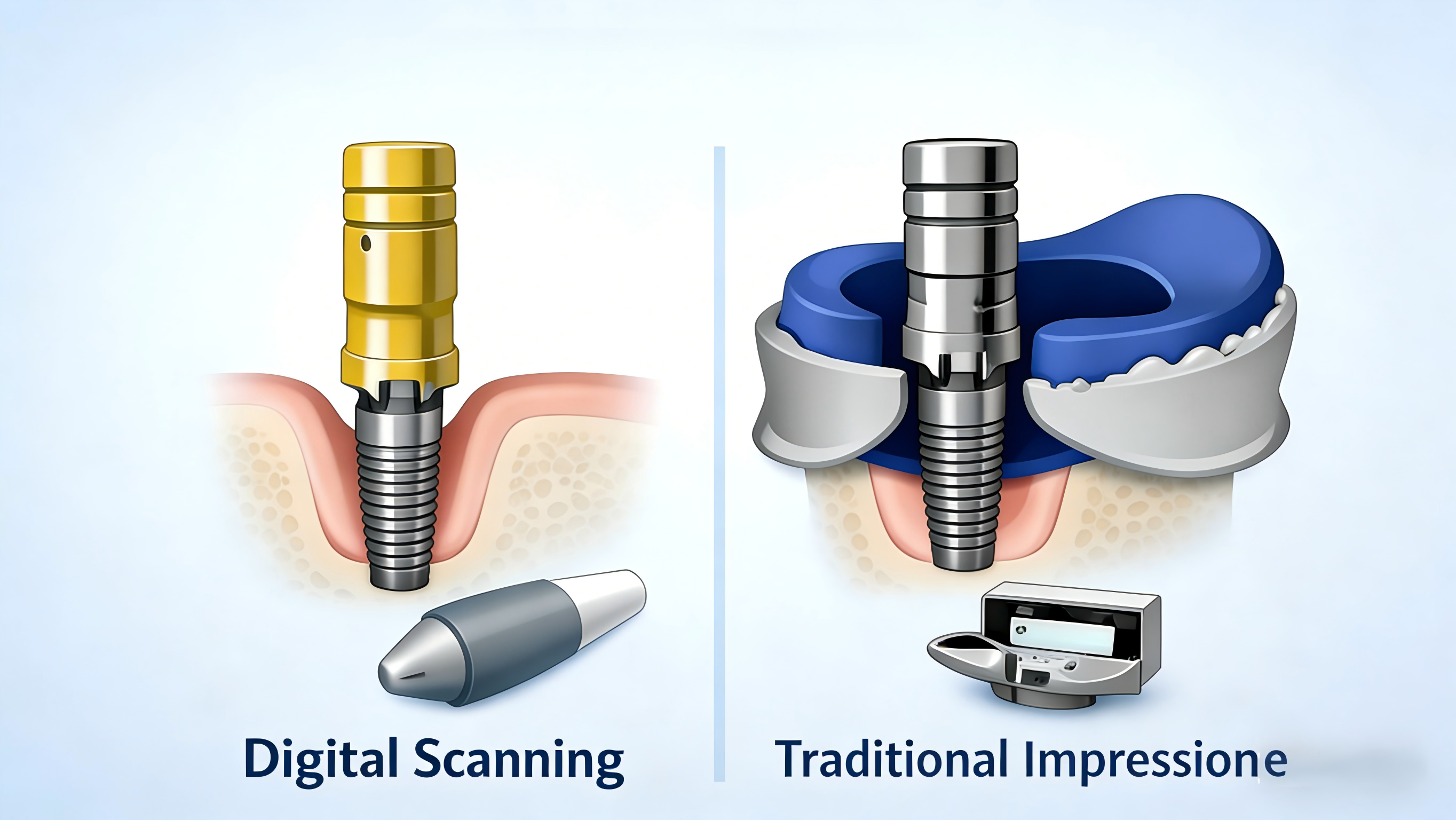
The use of scan bodies in digital dentistry provides several important benefits.
1.Higher Accuracy
Digital impressions allow precise capture of implant positions, improving restoration fit.
2.Better Patient Experience
Patients often prefer digital scanning because it eliminates uncomfortable impression materials.
3.Faster Turnaround Time
Digital workflows reduce laboratory processing time.
4.Improved Communication
Digital files can be instantly shared between clinics and laboratories.
These advantages have made digital scanning the standard workflow in many implant clinics and dental laboratories.
Choosing the correct scan body is essential for achieving accurate implant restorations.
Several factors should be considered.
The scan body must match the implant connection system used by the clinician.
Different intraoral scanners may require specific scan body geometries.
PEEK scan bodies are commonly preferred for intraoral scanning due to their scanning performance.
Full-arch restorations may require multi-unit scan bodies.
Dental laboratories and clinics should work with manufacturers that provide high-precision compatible scan bodies designed for digital implant workflows.When selecting scan bodies, it is important to choose reliable manufacturers that ensure accurate compatibility and stable scanning performance. Manufacturers such as Re-tech Dental offer compatible scan bodies for a wide range of implant systems.
Many scan bodies are designed to be compatible with widely used implant systems, including:
Compatibility with major implant systems allows dental laboratories and clinics to integrate scan bodies into their existing implant workflows without changing implant platforms.
A scan body transfers the precise position and orientation of a dental implant into digital CAD software during intraoral scanning.
Some scan bodies can be reused after proper sterilization, while others are designed for single use depending on the material and manufacturer.
When used with modern intraoral scanners and compatible CAD libraries, scan bodies can achieve extremely high accuracy for implant restorations.
No. Scan bodies must be specifically designed to match the implant system connection type.
For dental laboratories, distributors, and implant clinics, choosing a reliable scan body manufacturer is essential for ensuring accurate digital implant workflows.
High-quality scan bodies should provide:
Precise compatibility with major implant systems
High scanning accuracy
Durable materials such as PEEK or titanium
Stable CAD library support
Consistent manufacturing quality
Professional manufacturers specializing in dental implant components can also provide OEM and compatible scan bodies for distributors and dental brands.
For example, Re-tech Dental specializes in manufacturing dental implant components including scan bodies, implant analogs, and impression copings compatible with many popular implant systems used in digital dentistry.
Working with an experienced manufacturer ensures reliable digital implant workflows and consistent restoration outcomes.