![[slide:title]](/static/upload/other/20260512/1778551853592214.webp)
![[slide:title]](/static/upload/other/20260512/1778551954982306.webp)
Time:2026-03-13 Form:本站
What Is Guided Bone Regeneration (GBR) in Dentistry? A Comprehensive Guide
Guided Bone Regeneration (GBR) is one of the most important regenerative techniques used in modern implant dentistry. It is designed to rebuild alveolar bone in areas where bone volume is insufficient to support dental implants.
Bone deficiency is a common challenge in implant treatment planning. After tooth extraction, the alveolar ridge naturally undergoes resorption due to the loss of mechanical stimulation. Studies show that up to 40–60% of alveolar bone width may be lost within the first year following tooth loss.
This bone loss often prevents the placement of dental implants without prior augmentation procedures. Guided Bone Regeneration provides a predictable solution for rebuilding lost bone structure and creating adequate bone support for implants.
By using bone graft materials in combination with barrier membranes, clinicians can create a controlled environment that promotes bone regeneration while preventing soft tissue invasion.
Today, GBR has become a routine surgical procedure in implant dentistry and is widely used in ridge augmentation, implant site development, and treatment of peri-implant bone defects.
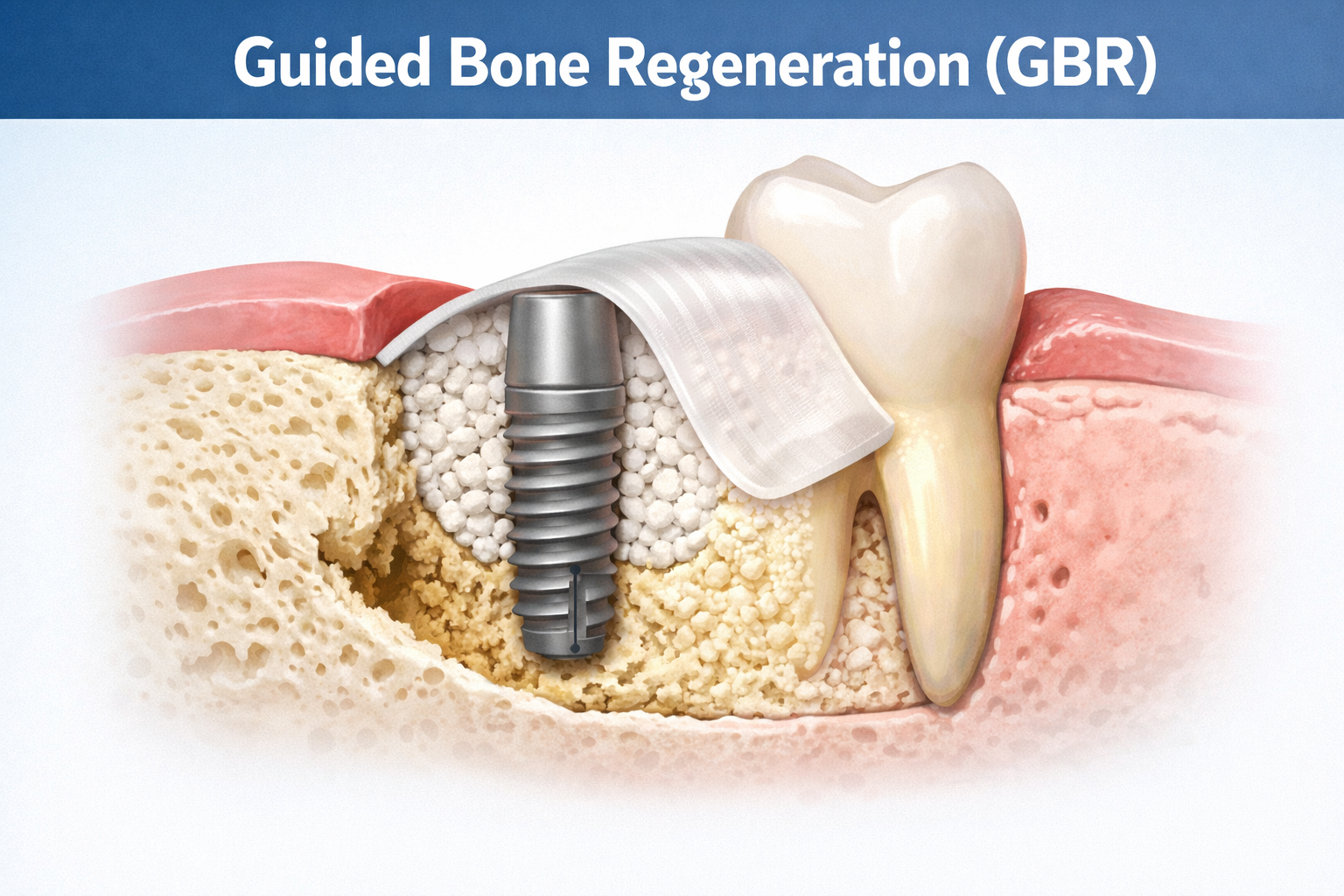
GBR stands for Guided Bone Regeneration, a regenerative surgical technique used to stimulate bone growth in areas where bone volume is insufficient.
The concept of GBR is based on the principle of selective cell repopulation. During wound healing, epithelial cells and fibroblasts grow faster than osteogenic cells. Without intervention, these soft tissue cells quickly occupy the bone defect area and prevent bone regeneration.
To overcome this limitation, a barrier membrane is placed over the bone defect. This membrane isolates the grafted area from surrounding soft tissues and creates a protected space where bone-forming cells can regenerate new bone tissue.
Successful dental implant placement requires adequate bone height, width, and density to achieve primary stability and long-term osseointegration.
However, many patients suffer from bone loss before implant treatment.
Common Causes of Bone Loss
Tooth Loss
After tooth extraction, the alveolar bone gradually resorbs due to the absence of functional stimulation.
Periodontal Disease
Chronic periodontal infection can destroy the supporting bone around teeth, leaving irregular bone defects.
Trauma or Infection
Accidents, fractures, or infection may lead to localized bone loss.
Congenital Bone Deficiencies
Some patients naturally have narrow alveolar ridges that cannot support implants without augmentation.
GBR helps reconstruct these bone deficiencies and expands treatment possibilities for implant therapy.
Successful GBR treatment relies on several key biological principles.
Cell Exclusion
Barrier membranes prevent epithelial cells and fibroblasts from migrating into the bone defect area.
Space Maintenance
The membrane creates a protected space that allows bone regeneration to occur.
Stability of the Blood Clot
A stable blood clot serves as the initial scaffold for tissue regeneration.
Adequate Blood Supply
Sufficient vascularization is necessary to deliver nutrients and growth factors required for bone healing.
Guided Bone Regeneration is a carefully planned surgical procedure designed to restore bone volume in deficient areas. Although protocols may vary depending on clinical conditions, the procedure typically follows several key steps.
The process begins with a detailed clinical examination and radiographic assessment. Dentists commonly use cone beam computed tomography (CBCT) to evaluate bone volume and determine the size and morphology of the bone defect.
Treatment planning includes:
l evaluating bone height and width
l analyzing anatomical structures
l selecting appropriate graft materials
l planning implant position
Accurate planning is essential for predictable outcomes.
A full-thickness mucoperiosteal flap is elevated to expose the bone defect. Proper flap design ensures adequate surgical access while preserving blood supply to the tissues.
The defect area is carefully cleaned. Granulation tissue and inflammatory tissue are removed to create a healthy environment for bone regeneration.
In some cases, decortication may be performed to stimulate blood supply and enhance bone healing.
Bone graft material is placed into the defect to act as a scaffold for new bone formation. Depending on the clinical situation, clinicians may use:
l autograft
l allograft
l xenograft
l synthetic bone substitutes
A barrier membrane is placed over the grafted site to isolate it from soft tissues. This membrane allows bone cells to regenerate while preventing epithelial cells from entering the defect.
In larger defects, additional devices may be used to stabilize the graft and maintain the regeneration space. These may include:
l titanium mesh
l fixation screws
l tenting screws
High-quality surgical components play an important role in achieving predictable outcomes. Implant surgical components supplied by manufacturers such as Re-tech Dental are designed to support modern regenerative procedures.
After membrane placement, the flap is repositioned and sutured. Surgeons aim to achieve tension-free primary closure to prevent membrane exposure.
Bone regeneration typically takes 4 to 9 months. After sufficient bone has formed, dental implants can be placed safely.
Several biomaterials are commonly used in GBR procedures.
l Autograft
l Allograft
l Xenograft
l Synthetic bone substitutes
l Resorbable collagen membranes
l Non-resorbable PTFE membranes
Additional surgical components such as titanium mesh and fixation screws may be used to stabilize the graft.
Guided Bone Regeneration (GBR) and Guided Tissue Regeneration (GTR) are regenerative techniques used in dentistry. Although both procedures utilize barrier membranes, they have different clinical objectives.
GBR is used to regenerate alveolar bone, most commonly to prepare sites for dental implant placement.
GTR is primarily used in periodontal therapy to regenerate tissues around natural teeth, including periodontal ligament and supporting bone.
Feature | GBR | GTR |
Full Name | Guided Bone Regeneration | Guided Tissue Regeneration |
Purpose | Bone regeneration | Periodontal tissue regeneration |
Typical Application | Implant dentistry | Periodontal therapy |
Target Tissue | Alveolar bone | Periodontal ligament and bone |
Although the biological principles are similar, the clinical applications differ significantly.
GBR is widely used in implant dentistry for:
l horizontal ridge augmentation
l vertical ridge augmentation
l implant site development
l socket preservation
l peri-implant bone defect treatment
l restores lost alveolar bone
l improves implant stability
l expands implant treatment possibilities
l improves aesthetic outcomes
l increases long-term implant success rates
Possible complications may include:
l membrane exposure
l infection
l graft instability
Proper surgical techniques and high-quality materials help minimize these risks.
1.Is GBR necessary for dental implants?
Not all implants require GBR. It is only necessary when bone volume is insufficient.
2.How long does a GBR procedure take?
GBR surgery usually takes 60–90 minutes depending on the defect size.
3.Can GBR be performed together with implant placement?
In some cases, GBR can be performed simultaneously with implant placement if the bone defect is small.
4.What is the success rate of GBR?
Clinical studies report success rates of over 90% when performed with proper surgical techniques.
Guided Bone Regeneration (GBR) has become a cornerstone technique in modern implant dentistry. By enabling clinicians to regenerate lost bone and restore alveolar ridge anatomy, GBR makes it possible to place dental implants in cases that were once considered difficult or impossible.
Successful GBR procedures rely on several key factors, including accurate diagnosis, proper surgical techniques, and the use of reliable regenerative materials and surgical components. When these elements work together, clinicians can achieve predictable bone regeneration and long-term implant stability.
As implant dentistry continues to advance, high-quality biomaterials and surgical solutions play an increasingly important role in supporting complex regenerative procedures. For dental professionals seeking dependable implant components and solutions for modern bone regeneration workflows, manufacturers such as Re-tech Dental provide products designed to support implant and GBR treatments.