![[slide:title]](/static/upload/other/20260512/1778551853592214.webp)
![[slide:title]](/static/upload/other/20260512/1778551954982306.webp)
Time:2026-04-02 Form:本站
Straumann vs Osstem Dental Implants: A Deep Technical Comparison for Clinics, Distributors, and Procurement Teams
In the global dental implant market, few comparisons are as frequently discussed as Straumann vs Osstem. These two brands represent different philosophies in implant design, pricing strategy, and clinical positioning. For dental clinics, distributors, and procurement professionals, understanding their differences is not just about brand preference—it directly impacts long-term clinical outcomes, cost structures, and patient satisfaction.
This article goes beyond surface-level comparisons. Instead of repeating common talking points, we will explore material science, surface engineering, biomechanics, clinical evidence, and supply chain implications, offering a nuanced perspective tailored for B2B decision-makers.
Straumann is widely recognized as a premium implant manufacturer headquartered in Switzerland. It has built its reputation on:
l Continuous R&D investment
l Proprietary materials (e.g., Roxolid®)
l Advanced surface technologies (e.g., SLActive®)
l Strong clinical documentation and long-term studies
Straumann positions itself at the high end of the market, targeting clinics that prioritize cutting-edge technology and are willing to pay a premium for predictable outcomes.
Osstem Implant, based in South Korea, has grown into one of the largest implant suppliers globally by volume. Its strategy focuses on:
l Cost-efficiency and accessibility
l Rapid global expansion
l Standardized systems with wide compatibility
l Strong presence in emerging markets
Osstem appeals to clinics and distributors seeking balance between cost and clinical reliability, particularly in price-sensitive regions.
Material choice directly affects osseointegration, fatigue resistance, and long-term stability.
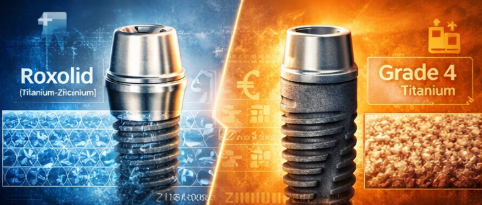
Straumann’s flagship innovation is Roxolid®, a titanium-zirconium alloy:
l ~85% titanium + 15% zirconium
l Higher tensile strength than pure titanium
l Allows for smaller diameter implants without compromising strength
This is particularly valuable in cases with limited bone volume or minimally invasive procedures.
Osstem primarily uses:
l Commercially pure titanium (Grade 4)
l Some higher-strength variants in newer lines
While not as advanced as titanium-zirconium alloys, these materials are:
l Clinically proven
l Cost-effective
l Suitable for standard implant indications
From a procurement standpoint:
l Straumann offers material innovation for complex cases
l Osstem provides reliable baseline performance at scale
For distributors, this often translates into tiered product portfolios rather than a single-brand strategy.
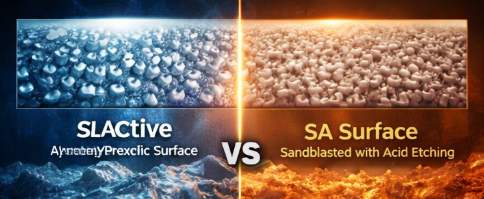
Surface treatment is one of the most critical differentiators in implant systems.
Straumann’s SLActive® surface is chemically modified to enhance hydrophilicity:
l Accelerates osseointegration
l Improves performance in compromised bone
l Enables shorter healing times
Clinical studies suggest faster integration compared to traditional SLA surfaces.
Osstem offers several surface treatments, including:
l SA (Sandblasted with Acid etching)
l CA (Calcium-modified surface)
These surfaces:
l Promote stable osseointegration
l Are widely accepted in clinical practice
l Offer solid performance for standard protocols
Feature | Straumann | Osstem |
Surface Type | SLActive® (hydrophilic) | SA / CA |
Healing Speed | Faster (in many cases) | Standard |
Performance in Poor Bone | Strong | Moderate |
Cost Impact | High | Moderate |
Straumann emphasizes:
l Precision engineering
l Tight tolerances
l Integrated digital workflows
Its systems are designed for premium prosthetic solutions, including CAD/CAM integration.
Osstem focuses on:
l Versatility
l Ease of use
l Compatibility with common prosthetic components
This makes Osstem particularly attractive for high-volume clinics and general practitioners.
Straumann has decades of clinical data, including:
l 10+ year survival rates
l Extensive peer-reviewed research
l Strong academic partnerships
This level of documentation is often critical for:
l Premium clinics
l Regulatory approvals
l Institutional procurement
Osstem also has growing clinical evidence, though:
l More recent compared to Straumann
l Strong in Asia-Pacific markets
l Increasing presence in international studies
l Straumann = deep, long-term evidence base
l Osstem = proven but still expanding globally
Cost is often the deciding factor in large-scale procurement.
l Premium pricing tier
l Higher upfront cost
l Potential for higher patient fees
l Competitive pricing
l Lower barrier to entry
l Enables more accessible treatment options
For clinics:
l Straumann may deliver higher margins per case
l Osstem enables higher case volume
For distributors:
l Straumann = brand-driven demand
l Osstem = volume-driven growth
One area often overlooked in comparisons is manufacturing flexibility.
Large global brands like Straumann and Osstem operate with fixed product lines and branding structures. However, many distributors and dental groups are increasingly exploring:
l Private label implant systems
l OEM manufacturing partnerships
l Customized product portfolios
This approach allows businesses to:
l Control pricing
l Build proprietary brands
l Differentiate in competitive markets
In this context, working with an experienced manufacturer such as RE-TECH can provide:
l Consistent quality aligned with international standards
l Flexible design and packaging options
l Scalable production capacity for global distribution
Rather than replacing established brands, this model often complements them—allowing distributors to balance premium, mid-range, and private-label offerings within one portfolio.
The answer depends on your business model.
l Target high-end patients
l Need strong clinical documentation
l Focus on advanced or complex cases
l Operate in price-sensitive markets
l Prioritize volume and accessibility
l Need a reliable, scalable system
l Want higher margins
l Plan to build your own brand
l Need flexibility in pricing and positioning
Not necessarily “better”—they serve different purposes. Straumann leads in innovation and premium positioning, while Osstem excels in cost-performance balance.
Both systems show high survival rates when properly placed. Straumann has more long-term published data supporting its performance.
Yes. Osstem is widely used globally and has proven reliability, especially in Asia and emerging markets.
Due to advanced materials, proprietary technologies, and extensive clinical research.
Yes. Many clinics use multiple systems to optimize cost, case complexity, and patient needs.
For distributors and large clinics, OEM solutions are increasingly popular due to better margin control and brand ownership.
The comparison between Straumann and Osstem reflects a broader truth in the dental implant industry: there is no one-size-fits-all solution.
Instead, the most successful clinics and distributors build multi-tiered strategies, combining:
l Premium innovation (Straumann)
l Cost-effective scalability (Osstem)
l Flexible manufacturing partnerships (OEM)
By aligning your implant selection with your clinical goals, market positioning, and long-term business strategy, you can create a sustainable competitive advantage in an increasingly crowded global market.