![[slide:title]](/static/upload/other/20260512/1778551853592214.webp)
![[slide:title]](/static/upload/other/20260512/1778551954982306.webp)
Time:2026-04-02 Form:本站
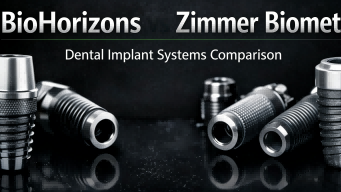 BioHorizons vs Zimmer Biomet: A Deep Comparison for Dental Professionals and Implant Buyers
Selecting a dental implant system is no longer just a clinical decision—it is increasingly a strategic business choice. For distributors, dental labs, private clinics, and procurement teams, the choice of implant brand directly affects cost structures, patient outcomes, workflow compatibility, and long-term scalability.
Among the most frequently compared premium systems are BioHorizons and Zimmer Biomet. Both are established players with strong reputations in global implant dentistry, but they differ significantly in design philosophy, surface technology, pricing, and ecosystem integration.
This article goes beyond surface-level comparisons. Instead of repeating common marketing claims, we’ll analyze:
l Implant design and biomechanics
l Surface treatment technologies
l Clinical performance and research backing
l Pricing structures and supply chain implications
l Digital workflow compatibility
l Suitability for different types of buyers
We’ll also explore an often-overlooked angle: how alternative manufacturing partners can deliver comparable value with greater flexibility for B2B buyers.
BioHorizons is a U.S.-based dental implant company known for its focus on biologically driven implant design. It has built its reputation around surface technology and tissue integration.
Key positioning:
l Strong emphasis on Laser-Lok® technology
l Focus on soft tissue attachment
l Widely used in North America and Europe

Zimmer Biomet is a global medical device giant with a large orthopedic and dental portfolio. Its implant systems are known for mechanical reliability and integration into broader digital dentistry workflows.
Key positioning:
l Extensive product ecosystem
l Strong global distribution network
l Integration with digital surgical and prosthetic solutions
BioHorizons designs often prioritize soft tissue stability. Their implants aim to:
l Preserve crestal bone
l Promote soft tissue attachment
l Reduce peri-implantitis risks
The Laser-Lok microchannel collar is specifically engineered to encourage connective tissue attachment, not just osseointegration.
This makes BioHorizons particularly attractive for:
l Esthetic zones
l Cases requiring long-term tissue stability
Zimmer Biomet focuses heavily on:
l Primary stability
l Load distribution
l Prosthetic versatility
Their systems are designed to perform consistently across:
l Immediate loading cases
l Complex restorations
l Full-arch solutions
Zimmer implants often feature aggressive thread designs and robust connection systems, making them popular in demanding surgical scenarios.
Surface treatment is one of the most critical factors in implant success.
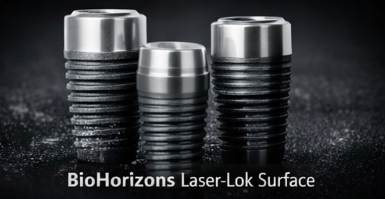
Laser-Lok is not a coating but a precision-engineered microchannel surface. It aims to:
l Enhance bone-to-implant contact
l Encourage soft tissue attachment
l Reduce epithelial downgrowth
Clinical studies suggest improved crestal bone preservation compared to traditional roughened surfaces.
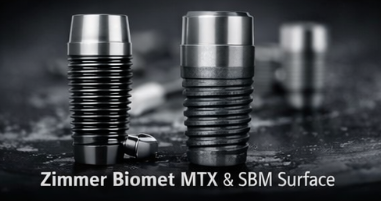
Zimmer Biomet uses:
l MTX (Microtextured Surface)
l SBM (Sandblasted, Acid-Etched Surface)
These are designed to:
l Increase surface roughness
l Accelerate osseointegration
l Provide predictable healing
While effective, these approaches are more conventional compared to Laser-Lok’s differentiated design.
l Strong focus on soft tissue integration studies
l Long-term data supports crestal bone maintenance
l Popular in esthetic dentistry
l Extensive global clinical data
l Proven success in full-arch and load-bearing cases
l Widely trusted in institutional settings
Key Insight:
BioHorizons tends to stand out in biological integration, while Zimmer Biomet excels in mechanical predictability and versatility.
l Compatible with major prosthetic solutions
l Simpler ecosystem
l Easier adoption for smaller clinics
l Highly integrated digital workflow
l CAD/CAM compatibility
l Broad prosthetic libraries
Zimmer Biomet is often preferred by:
l Large clinics
l Digital dentistry centers
l Labs requiring standardized workflows
This is where the biggest differences emerge for B2B buyers.
l Premium pricing tier
l Justified by unique surface technology
l Moderate flexibility in bulk purchasing
l Also premium-priced
l Higher costs due to brand and ecosystem
l Strong distributor control
For distributors and clinics scaling operations, the challenge is not just performance—it’s cost-performance ratio.
Many buyers are now asking:
Can we achieve similar clinical outcomes without premium brand pricing?
While BioHorizons and Zimmer Biomet dominate the premium segment, the global implant market has evolved.
High-quality OEM/ODM manufacturers now offer:
l Comparable materials (Grade 4 titanium, Ti-6Al-4V ELI)
l Advanced surface treatments
l Customization options
l Significantly lower costs
For example, manufacturers like RE-TECH focus on:
l Precision CNC manufacturing
l Flexible design adaptation
l OEM branding for distributors
l Stable quality control systems aligned with international standards
Rather than replacing premium brands entirely, many buyers adopt a hybrid sourcing strategy:
l Use premium brands for high-risk or esthetic cases
l Use reliable alternative systems for standard procedures
This approach improves margins without compromising outcomes.
l Strong but regionally concentrated supply chain
l Limited customization
l Global distribution strength
l Reliable but less flexible
OEM-focused manufacturers provide:
l Faster lead times
l Lower MOQs
l Custom packaging and branding
l Adaptability to local market needs
For growing distributors, this flexibility can be more valuable than brand recognition alone.
The answer depends entirely on your role.
l Choose BioHorizons for esthetics and tissue stability
l Choose Zimmer Biomet for complex, load-bearing cases
l BioHorizons: easier positioning in premium niche markets
l Zimmer Biomet: stronger brand recognition
Neither may be the most cost-efficient at scale.
A mixed sourcing model—combining premium systems with high-quality manufacturing partners—often delivers better ROI.
Not necessarily. BioHorizons focuses more on soft tissue integration, while Zimmer Biomet excels in mechanical stability and system versatility.
Both have excellent long-term success rates (typically above 95%). The difference lies more in application scenarios than overall reliability.
Costs are driven by:
l Brand positioning
l Clinical research investment
l Distribution networks
l Regulatory compliance
Yes—if sourced from qualified manufacturers with:
l ISO certifications
l Strict quality control
l Proven export experience
Yes. Many manufacturers now offer OEM/ODM services, allowing distributors to:
l Customize designs
l Apply private labeling
l Control pricing strategies
The comparison between BioHorizons and Zimmer Biomet highlights a broader trend in implant dentistry:
The shift from brand-driven decisions to value-driven strategies.
While premium brands continue to set benchmarks, the gap between branded systems and high-quality manufacturers is narrowing.
For B2B buyers, the real opportunity lies in:
l Understanding clinical requirements
l Optimizing cost structures
l Building flexible supply chains
In this evolving landscape, those who balance performance, price, and scalability will gain the strongest competitive advantage.