![[slide:title]](/static/upload/other/20260512/1778551853592214.webp)
![[slide:title]](/static/upload/other/20260512/1778551954982306.webp)
Time:2026-04-01 Form:本站
Korea vs Germany Dental Implants: A Deep Technical & Commercial Comparison for Global Buyers
In today’s global dental implant market, two countries consistently stand out for their influence, reputation, and export volume: South Korea and Germany.
For distributors, private-label brands, and dental chains, choosing between Korean and German implant systems is not just a matter of price—it involves evaluating engineering philosophy, manufacturing precision, surface technology, regulatory frameworks, and long-term clinical predictability.
This article goes beyond the usual surface-level comparisons. Instead of repeating generic claims like “German quality” or “Korean affordability,” we will break down:
l The real technical differences
l The manufacturing ecosystems behind each country
l The hidden cost structures
l The OEM/private label opportunities
l And how global buyers can make smarter sourcing decisions
Germany’s dental implant industry evolved alongside its broader strength in precision manufacturing and medical engineering. Brands like Straumann (Swiss but heavily influenced by European engineering standards) and Camlog operate within a system that prioritizes:
l Strict regulatory compliance (CE MDR)
l Long-term clinical data
l Conservative innovation cycles
German implants are typically positioned as premium, reliability-first solutions, often backed by decades of clinical documentation.
South Korea entered the implant market later but scaled rapidly, becoming one of the largest global exporters. Korean manufacturers focused on:
l Fast product iteration
l Cost-efficient production
l Strong domestic adoption (high implant penetration rate)
Companies like Osstem and Dentium built systems that are:
l Clinically reliable
l Highly competitive in pricing
l Designed for global distribution at scale
Key Insight:
Germany optimized for stability and legacy, while Korea optimized for speed and accessibility.
German implant production emphasizes:
l CNC machining with ultra-tight tolerances
l Automated quality inspection systems
l Documentation-heavy traceability
Production environments are often aligned with:
l ISO 13485 medical standards
l EU MDR compliance
l Strict batch validation protocols
This results in:
l Extremely consistent product quality
l Higher production costs
l Longer lead times
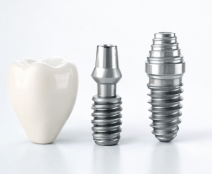
Korean manufacturers adopt ahybrid approach:
l Advanced CNC machining (often comparable to European standards)
l Semi-automated + scalable production lines
l Flexible batch sizes
Strengths include:
l Faster turnaround
l Lower cost per unit
l Strong OEM adaptability
However, variability between manufacturers can be wider than in Germany.
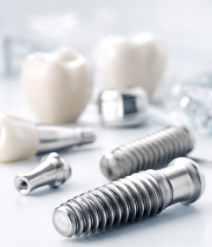
l If your brand requires ultra-premium positioning, German supply chains offer reassurance.
l If your business depends on scalability and margin control, Korean systems are often more practical.
Surface treatment is one of the most critical factors affecting osseointegration.
German implants often use:
l SLA (Sandblasted, Large grit, Acid-etched)
l Modified hydrophilic surfaces
Characteristics:
l Highly controlled roughness
l Excellent long-term clinical validation
l Conservative innovation pace
Korean manufacturers have aggressively innovated in this area:
l SLA variants
l RBM (Resorbable Blast Media)
l Calcium-treated surfaces
l UV-treated hydrophilic surfaces
Advantages:
l Faster osseointegration claims
l Competitive differentiation
l Lower production cost
While marketing often emphasizes surface innovation, clinical outcomes between top-tier Korean and German implants are increasingly comparable.
The real difference lies in:
l Consistency
l Validation depth
l Brand trust
Cost drivers include:
l Labor cost
l Regulatory compliance (EU MDR is expensive)
l Brand premium
l Distribution layers
Result:
l High price per implant
l Lower margin flexibility for distributors
Cost advantages come from:
l Efficient manufacturing
l Government-supported medical exports
l High-volume production
Result:
l Competitive pricing
l Strong margins for distributors and private labels
Buyers often overlook:
l MOQ requirements
l Packaging customization costs
l Logistics and lead time
l After-sales technical support
This is where the biggest practical difference lies for B2B buyers.
Most German manufacturers:
l Focus on their own brands
l Offer limited OEM/private labeling
l Require high entry barriers
Korean manufacturers are:
l Highly experienced in OEM production
l Flexible in customization
l Open to branding partnerships
This makes Korea a strong choice for:
l Distributors building their own brand
l Dental chains launching proprietary systems
l Regional implant brands
In recent years, some global buyers have shifted toward hybrid sourcing strategies, combining:
l European design standards
l Asian manufacturing efficiency
This approach allows:
l Cost optimization
l Faster go-to-market
l Greater control over branding
From a purely clinical perspective:
l Both Korean and German implants show high survival rates (>95%)
l Differences are becoming less clinically significant
However:
l German systems tend to have longer-term data (10–20+ years)
l Korean systems often have strong mid-term data (5–10 years)
Perceived as:
l Premium
l Reliable
l “Safe choice” for clinicians
Perceived as:
l Cost-effective
l Modern
l Rapidly improving
Perception often matters as much as reality.
If your market values:
l Prestige → German systems help positioning
l Value → Korean systems drive adoption
A growing number of distributors are no longer choosing strictly between Korea and Germany.
Instead, they are:
l Partnering with advanced OEM manufacturers
l Developing custom implant systems
l Building independent brands
This approach offers:
l Higher margins
l Brand ownership
l Long-term scalability
In practice, many experienced buyers have realized:
l The gap in manufacturing capability between top Asian and European factories has narrowed significantly
l The biggest differentiator is no longer just “country of origin”
l It is quality control systems, engineering consistency, and customization capability
For example, some OEM-focused manufacturers(RE-TECH) now provide:
l Precision machining aligned with international standards
l Custom implant design and packaging
l Flexible production volumes
This enables distributors to create systems that combine:
l European-level reliability expectations
l Asian-level cost efficiency
Not necessarily. While German implants have longer clinical histories, top Korean systems demonstrate comparable success rates in modern studies.
Due to:
l Higher labor costs
l Strict regulatory frameworks
l Brand positioning
Yes—especially newer systems with advanced surface technologies. However, branding and perception still play a role.
Korean manufacturers are generally more suitable due to:
l OEM flexibility
l Lower MOQs
l Faster production
Increasingly, yes—especially when working with high-end OEM manufacturers that focus on precision and quality control rather than mass production alone.
The comparison between Korean and German dental implants is no longer a simple debate of quality vs cost.
Instead, it has evolved into a more nuanced decision involving:
l Business strategy
l Brand positioning
l Supply chain flexibility
l Long-term scalability
For B2B buyers, the smartest approach is not to follow outdated assumptions, but to evaluate:
l Actual manufacturing capability
l Engineering standards
l OEM support
l Total cost of ownership
In today’s market, success belongs to those who can balance performance, cost, and brand control—rather than relying solely on country-of-origin perceptions.