![[slide:title]](/static/upload/other/20260512/1778551853592214.webp)
![[slide:title]](/static/upload/other/20260512/1778551954982306.webp)
Time:2026-04-13 Form:本站
What Is RBM in Dental Implants? A Deep Technical and Commercial Guide for Buyers
Surface treatment is one of the most decisive factors in dental implant performance, yet it is often misunderstood—even among experienced buyers and distributors. While terms like SLA and hydrophilic surfaces dominate marketing conversations, RBM (Resorbable Blast Media) remains a widely used, cost-effective, and clinically reliable surface treatment—especially in value-driven implant systems.
For procurement managers, OEM partners, and dental brands, understanding RBM is not just about surface roughness—it is about manufacturing philosophy, biological response, cost-performance balance, and long-term clinical predictability.
This article provides a deep, technical, and commercially relevant breakdown of RBM, how it compares to other surface treatments, and where it fits in modern implant sourcing strategies.
RBM stands for Resorbable Blast Media, a surface treatment process used to create controlled roughness on dental implants.
Core Principle
RBM works by blasting the implant surface with biocompatible, resorbable particles—typically:
l Calcium phosphate
l Hydroxyapatite particles
These particles impact the titanium surface at high velocity, creating micro-scale roughness. After blasting, the residual particles are removed through cleaning processes or naturally dissolve (resorb), hence the name.
Key Outcome
The result is a moderately rough surface that enhances:
l Bone-to-implant contact (BIC)
l Initial mechanical stability
l Osseointegration speed (compared to smooth surfaces)
Unlike acid-etched surfaces, RBM relies primarily on mechanical modification, not chemical alteration.
Before comparing RBM to other treatments, it’s important to understand a key concept:
Implant success is not driven by brand name—it is driven by surface-topography + cleanliness + consistency.
RBM occupies a unique position because it delivers:
l Reliable roughness
l Lower manufacturing complexity
l Reduced chemical risks
This makes it especially attractive for OEM production and private-label implant systems.
RBM surfaces typically achieve:
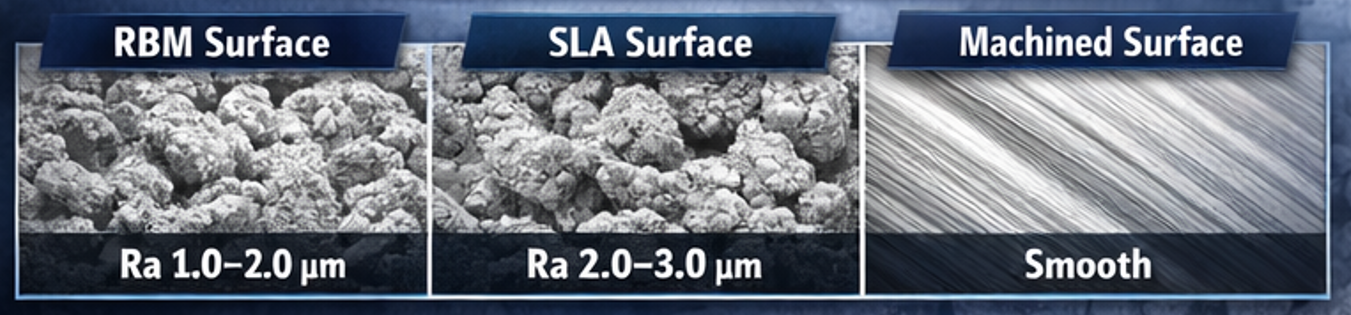
l Ra (average roughness): 1.0–2.0 μm
l Micro-scale irregularities without deep porosity
This level of roughness is considered optimal for osteoblast attachment, balancing:
l Stability
l Cleanability
l Long-term bone response
Unlike SLA (Sandblasted, Large Grit, Acid-etched), RBM:
l Does NOT use strong acids
l Avoids micro-pitting at nano level
This leads to:
l Lower risk of chemical residues
l More predictable surface chemistry
One of the most critical (and often overlooked) factors:
RBM surfaces are only as good as the post-blasting cleaning process.
High-quality RBM implants undergo:
l Ultrasonic cleaning
l Passivation
l Strict contamination control
Poorly controlled RBM processes can leave embedded particles, which is a major risk in low-end manufacturing.
To fully understand RBM’s value, we need to compare it with mainstream alternatives.
Feature | RBM | SLA |
Process | Blasting only | Blasting + acid etching |
Roughness | Moderate | Moderate to high |
Surface complexity | Micro-scale | Micro + nano-scale |
Cost | Lower | Higher |
Osseointegration speed | Good | Faster |
Residue risk | Mechanical particles | Chemical residues |
Insight:
SLA is often marketed as superior, but RBM can achieve comparable clinical outcomes in standard cases, especially when manufacturing quality is high.
Feature | RBM | Machined |
Surface texture | Rough | Smooth |
Bone integration | Strong | Weak |
Healing time | Faster | Slower |
Primary stability | Higher | Lower |
Insight:
RBM represents a major upgrade over traditional smooth implants and is now considered a baseline standard in modern implantology.
Feature | RBM | Hydrophilic |
Surface chemistry | Neutral | Chemically activated |
Wettability | Standard | High |
Healing speed | Good | Very fast |
Storage | Simple | Controlled environment |
Cost | Lower | Higher |
Insight:
Hydrophilic surfaces are ideal for premium and advanced cases, but RBM remains highly competitive for routine clinical applications and cost-sensitive markets.
A common misconception is that RBM is “outdated.” This is not accurate.
RBM implants have demonstrated:
l High survival rates (>95% in many studies)
l Stable long-term bone levels
l Reliable performance in standard bone conditions

RBM is particularly suitable for:
l Routine implant cases
l Dense bone (D1–D2)
l Cost-sensitive healthcare systems
l Large-scale clinical deployments
RBM may be less optimal in:
l Poor bone quality (D3–D4)
l Immediate loading protocols
l High-end aesthetic zones
For distributors and implant brands, RBM is not just a technical choice—it is a manufacturing strategy.
RBM offers:
l Fewer process variables
l Easier quality control
l Scalable production
Compared to SLA, it reduces:
l Chemical handling risks
l Batch variability
RBM enables:
l Lower production costs
l Competitive pricing
l Higher margins for distributors
This is especially important for:
l Emerging markets
l Private-label implant brands
RBM is highly adaptable for:
l Custom implant designs
l Private branding
l Volume manufacturing
Factories with strong RBM capability can deliver consistent quality without premium pricing pressure.
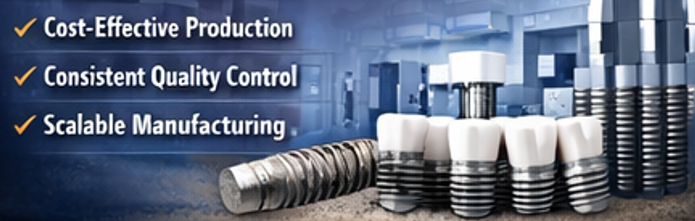
In recent OEM manufacturing environments, RBM surface treatment has undergone significant refinement. Some specialized manufacturers have optimized blasting parameters, particle purity, and post-treatment cleaning protocols to achieve more uniform roughness and lower contamination risk than traditional RBM processes.
For example, manufacturers such as RE-TECH have focused on improving process stability and batch consistency, particularly for large-scale OEM production. This reflects a broader industry shift where RBM is no longer treated as a “low-end” option, but rather as a controlled and scalable surface solution for global implant distribution.

Not all RBM implants are equal.
Key Risks
1. Residual Blasting Particles
l Poor cleaning can leave calcium phosphate debris
l May affect osseointegration
2. Inconsistent Roughness
l Uneven blasting leads to unpredictable performance
3. Surface Contamination
l Oil, dust, or handling contamination
What to Ask Your Supplier
B2B buyers should verify:
l Surface roughness testing reports (Ra values)
l Cleaning and passivation process
l SEM (Scanning Electron Microscope) images
l Residue analysis
The implant market is evolving into three tiers:
l Hydrophilic / nano-modified surfaces
l High cost, high performance
l SLA and advanced RBM
l Balance of cost and performance
l RBM-dominant
l Cost-driven but clinically viable
RBM continues to dominate mid-to-value segments, which represent the largest global demand.
From a sourcing perspective, the real question is not:
“Is RBM better than SLA?”
But rather:
“Is this RBM surface manufactured with premium-level control?”
A well-produced RBM implant can outperform a poorly controlled SLA implant.
In recent years, some specialized manufacturers have refined RBM processes to achieve:
l More uniform roughness
l Cleaner surfaces
l Improved consistency across batches
For buyers, this means RBM is no longer just a “low-cost option”—it can be a strategic choice for scalable, reliable implant systems, especially when working with experienced production partners
No. RBM remains widely used and clinically reliable. While SLA offers additional micro/nano features, RBM still performs well in most standard cases.
When properly manufactured, RBM implants achieve high success rates comparable to other roughened surfaces.
Yes—provided the blasting media is fully removed and the surface is properly cleaned.
RBM avoids acid etching and complex chemical processes, reducing manufacturing cost and variability.
RBM is a strong choice if your priorities include:
l Cost efficiency
l Stable quality
l Scalable production
Traditionally less common, but with improved manufacturing control, RBM can now meet higher standards than before.
RBM is often underestimated—not because of its performance, but because of how it is positioned in the market.
In reality, RBM represents:
l A proven, clinically reliable surface treatment
l A cost-effective manufacturing solution
l A scalable option for global implant distribution
For B2B buyers, the real competitive advantage lies not in chasing the most “advanced” surface—but in selecting a surface that delivers consistent results, supply stability, and commercial viability.
And in that equation, RBM continues to play a critical role.