![[slide:title]](/static/upload/other/20260512/1778551853592214.webp)
![[slide:title]](/static/upload/other/20260512/1778551954982306.webp)
Time:2026-04-13 Form:本站
Dental Implant Surface Treatment Guide: Science, Performance, and Strategic Selection
When evaluating dental implants, most discussions still revolve around macro factors—material grade, implant geometry, or cost. However, experienced manufacturers and procurement specialists increasingly understand that surface treatment is the true performance differentiator.
Surface engineering directly influences:
l Osseointegration speed
l Bone-to-implant contact (BIC) ratio
l Long-term stability under cyclic loading
l Risk of peri-implantitis
For B2B buyers—whether distributors, clinics, or OEM partners—the ability to evaluate surface technologies beyond marketing claims is becoming a key competitive advantage.
This guide goes beyond basic explanations. It provides:
l A deep technical breakdown of major surface treatments
l Comparative performance insights grounded in real-world application
l Procurement-level evaluation criteria
l A practical framework for choosing the right surface strategy
At its core, dental implant surface treatment aims to modify three critical parameters:
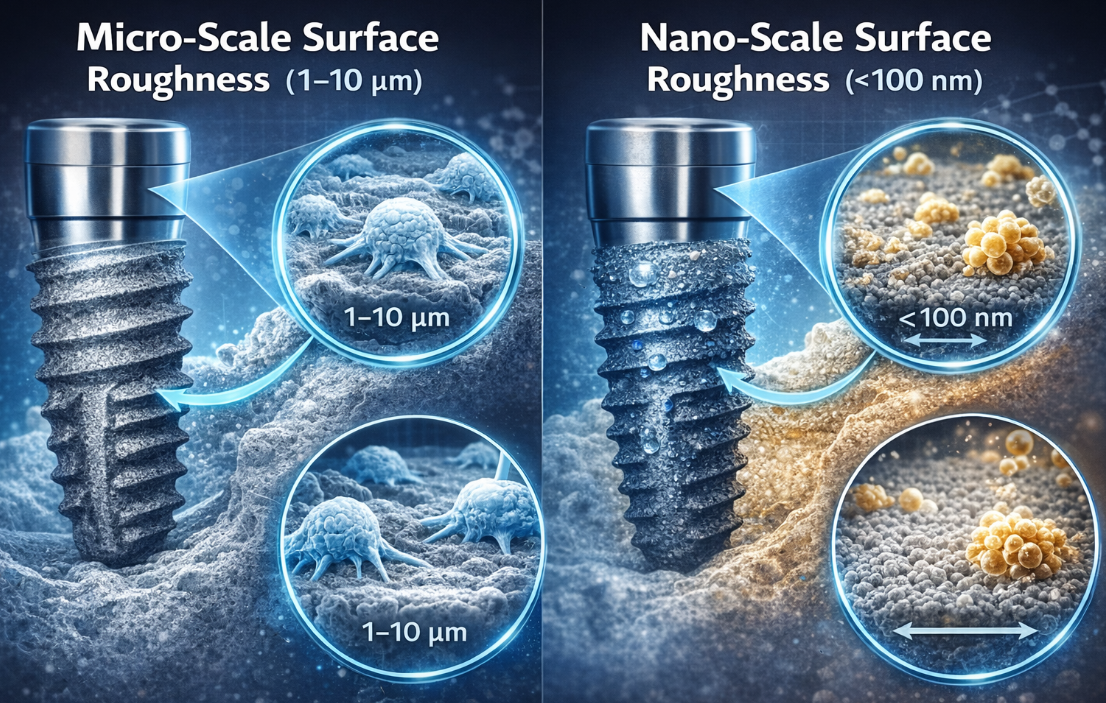
Surface roughness enhances mechanical interlocking between bone and implant.
l Micro-roughness (1–10 μm) → improves osteoblast attachment
l Nano-roughness (<100 nm) → influences protein adsorption and cell signaling
A dual-scale structure is now widely considered optimal.
Surface chemistry determines how the implant interacts with biological fluids:
l Titanium oxide (TiO₂) layer stability
l Surface energy and wettability
l Ion exchange behavior
Hydrophilic surfaces significantly improve early healing.
Hydrophilic surfaces:
l Promote faster blood wetting
l Enhance fibrin network formation
l Accelerate early-stage osseointegration
Hydrophobic surfaces, by contrast, delay biological interaction.
Overview:
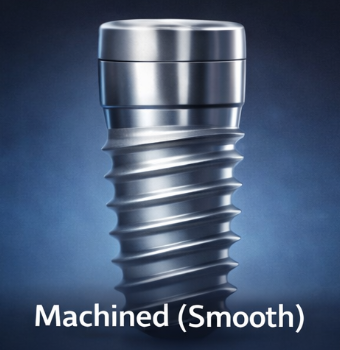
Early-generation implants featured minimally treated, polished surfaces.
Advantages:
l Lower bacterial adhesion
l Easier cleaning
Limitations:
l Poor osseointegration
l Longer healing time
l Lower primary stability
Use case today:
Rarely used in modern systems except in niche applications.
Process:
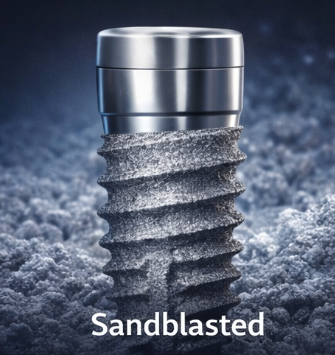
High-pressure blasting with abrasive particles (often alumina or titanium oxide).
Effect:
l Creates macro-roughness
l Improves mechanical interlocking
Challenges:
l Risk of residual blasting media contamination
l Inconsistent surface structure
Overview:
The industry benchmark for decades.
Process:
1. Sandblasting for macro-roughness
2. Acid etching for micro-porosity
Advantages:
l Strong bone integration
l Proven clinical track record
l Balanced performance and cost
Limitations:
l Hydrophobic unless further treated
l Limited nano-scale control
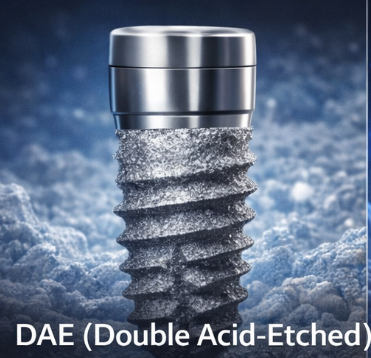
Process:
Acid treatment without sandblasting.
Advantages:
l Clean surface (no blasting residue)
l Controlled micro-roughness
Limitations:
l Less macro retention compared to SLA
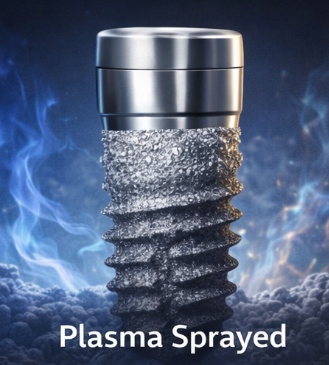
Process:
Titanium plasma sprayed onto implant surface.
Advantages:
l High roughness
l Strong initial fixation
Limitations:
l Coating delamination risk
l Long-term stability concerns
Trend:
Largely replaced by more stable surface technologies.
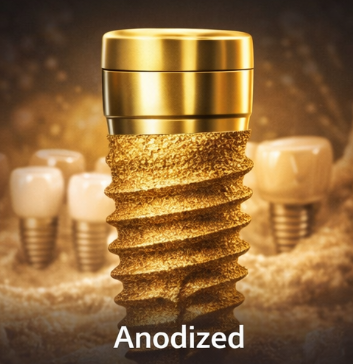
Process:
Electrochemical oxidation creates a thick porous oxide layer.
Advantages:
l Enhanced bioactivity
l Increased surface area
l Good integration in low-density bone
Limitations:
l Process complexity
l Cost variability
Process:
Post-treatment modification to increase surface energy.
Methods include:
l Nitrogen storage
l Plasma cleaning
l Chemical activation
Advantages:
l Faster osseointegration
l Better early-stage stability
Overview:
Next-generation surfaces engineered at the nanoscale.
Technologies:
l Laser structuring
l Chemical deposition
l Nanotube formation
Advantages:
l Mimics natural bone structure
l Enhances protein interaction
l Promotes faster healing
Surface Type | Osseointegration Speed | Stability | Cost | Risk Factors |
Machined | Low | Low | Low | Poor integration |
Sandblasted | Medium | Medium | Low | Contamination |
SLA | High | High | Medium | Hydrophobicity |
DAE | Medium-High | Medium | Medium | Limited macro grip |
TPS | High (initial) | Medium | High | Delamination |
Anodized | High | High | High | Process variability |
Hydrophilic | Very High | High | High | Storage sensitivity |
Nano-modified | Very High | Very High | Premium | Manufacturing complexity |
Key Insight for B2B Buyers:
There is no “best” surface universally. The optimal choice depends on:
l Target market (premium vs cost-sensitive)
l Clinical positioning
l Regulatory environment
l Supply chain consistency
Even advanced surfaces can fail if contamination exists:
l Residual blasting particles
l Organic contaminants
l Improper packaging
Surface purity often matters more than complexity.
A major issue in OEM sourcing:
l Lab-level performance ≠ mass production consistency
Ask suppliers:
l What is the process control tolerance?
l How is batch-to-batch consistency validated?
Hydrophilic surfaces degrade over time if exposed to air.
Critical questions:
l Is the implant stored in inert gas?
l What is the shelf-life stability?
Different markets require different validation levels:
l EU (MDR): strict documentation
l US (FDA): clinical equivalence or trials
l Emerging markets: cost-performance balance
l Premium segment → hydrophilic + nano
l Mid-range → SLA or anodized
l Cost-sensitive → optimized SLA or DAE
l Immediate loading → hydrophilic
l Low-density bone → anodized
l General use → SLA
Look beyond brochures:
l Surface characterization reports (SEM, Ra values)
l Cleanliness testing
l Process repeatability
Over-engineering surface treatment can:
l Increase cost unnecessarily
l Reduce competitiveness in price-sensitive markets
From a manufacturing standpoint, the real challenge is not creating advanced surfaces—but delivering them consistently at scale while maintaining cost efficiency.
Some suppliers focus heavily on marketing surface names, but experienced B2B buyers tend to prioritize:
l Stability of supply
l Quality control systems
l Customization flexibility
l Long-term partnership capability
Manufacturers that integrate precision surface engineering with scalable production systems are typically better positioned to support OEM clients and distributors.
In recent years, some implant manufacturers have moved toward combining:
l Controlled SLA-based microstructures
l Enhanced cleaning protocols
l Optional hydrophilic activation
This hybrid approach often achieves a balance between:
l Performance
l Cost
l Manufacturing reliability
From a manufacturing standpoint, the real challenge is not developing advanced surface treatments, but ensuring they can be consistently reproduced at scale without compromising cleanliness or cost efficiency.
In practice, some implant manufacturers have shifted toward a more balanced approach—combining controlled SLA-based microstructures with enhanced cleaning protocols and optional hydrophilic activation.
For example, manufacturers such as RE-TECH have focused on optimizing this balance by refining process stability and surface consistency rather than over-complicating surface design. This approach can be particularly relevant for OEM buyers who prioritize long-term supply reliability and predictable clinical performance.

l Growth factors
l Antibacterial agents
l Responsive to biological signals
l Simulation-based microstructure optimization
l Silver ion coatings
l Nano-texturing to reduce biofilm formation
No. Excessive roughness can increase bacterial adhesion. Balance is key.
For immediate loading or complex cases, yes. For standard cases, not always necessary.
Request:
l SEM images
l Roughness (Ra) data
l Cleanliness reports
SLA and its variations remain the global standard due to reliability and cost balance.
They can improve early-stage healing, but long-term success depends on multiple factors.
Dental implant surface treatment is no longer just a technical detail—it is a strategic decision that impacts product positioning, clinical outcomes, and market competitiveness.
For B2B buyers, the goal is not to chase the most advanced technology, but to select a surface solution that aligns with market needs, cost structure, and supply reliability.
In a competitive global market, success comes from combining:
l Scientifically validated surface engineering
l Consistent manufacturing quality
l Practical cost-performance balance
Those who understand this balance will be better positioned to build scalable, profitable implant businesses.