![[slide:title]](/static/upload/other/20260512/1778551853592214.webp)
![[slide:title]](/static/upload/other/20260512/1778551954982306.webp)
Time:2026-05-06 Form:本站
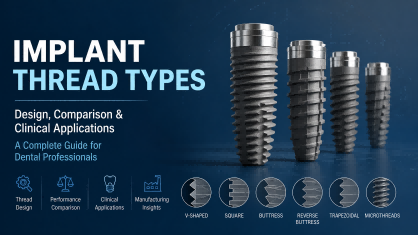 Implant Thread Types: A Comprehensive Guide for Dental Manufacturers and Buyers
Dental implant design has evolved far beyond simple cylindrical screws. Among all structural elements, thread geometry remains one of the most critical yet often misunderstood factors influencing implant stability, osseointegration, and long-term clinical success.
For manufacturers, distributors, and dental labs sourcing implants or components, understanding thread types is not just a technical detail—it directly impacts product positioning, clinical performance, and market competitiveness.
This guide breaks down implant thread types in depth, compares their mechanical and biological behavior, and explores how design choices align with real-world clinical scenarios.
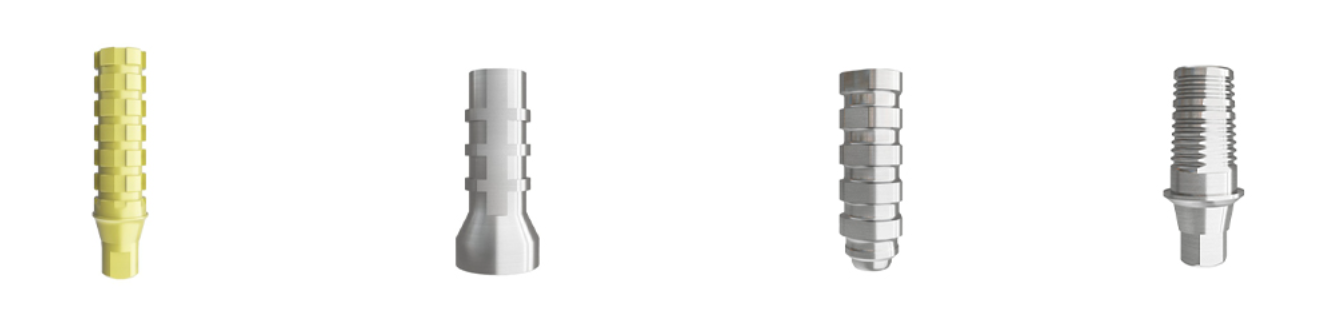
At first glance, threads may seem like a basic mechanical feature. In reality, they serve multiple complex functions:
l Primary stability: Determines how well the implant anchors immediately after placement
l Load distribution: Affects how occlusal forces transfer to surrounding bone
l Bone response: Influences stress patterns, microstrain, and remodeling
l Insertion torque: Impacts surgical feel and risk of over-compression
Unlike orthopedic screws, dental implants interact with living bone tissue that remodels over time. This makes thread design a balance between mechanical efficiency and biological compatibility.
Before diving into types, it’s important to understand the core variables:
The cross-sectional geometry of the thread.
Distance between adjacent threads—affects insertion speed and contact area.
How deep the thread cuts into bone—linked to stability.
The angle between thread flanks—affects stress distribution.
The spiral angle of the thread—impacts insertion mechanics.
Each implant system combines these variables differently to target specific clinical outcomes.
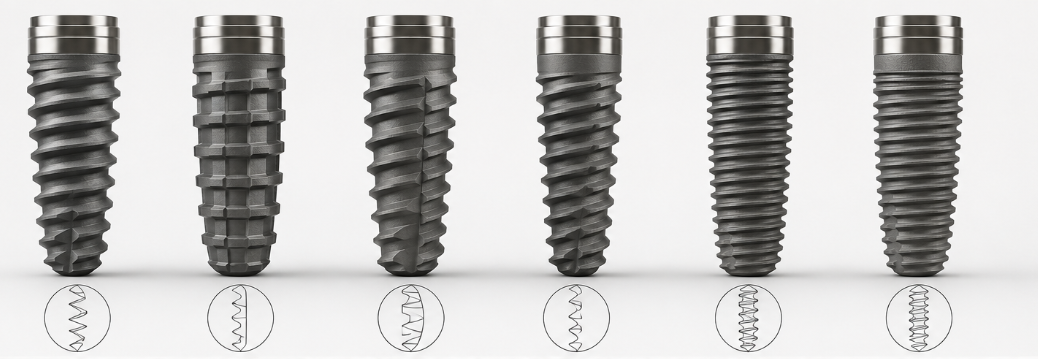
Overview
The most traditional and widely used thread design, characterized by a triangular cross-section.
Mechanical Behavior
l Converts vertical loads into lateral forces
l Moderate bone contact area
l Balanced insertion torque
Advantages
l Easy to manufacture
l Suitable for general-purpose implants
l Good for dense bone (D1–D2)
Limitations
l Generates more shear stress than compressive stress
l Less ideal for soft bone conditions
Best Use Case
l Standard implants in patients with good bone density
Overview
Square threads feature flat tops and vertical sides, creating a box-like geometry.
Mechanical Behavior
l Converts load into compressive forces, which bone tolerates better
l Minimizes shear stress
Advantages
l Excellent load distribution
l Reduced bone resorption risk
l High long-term stability
Limitations
l More difficult to manufacture
l Slightly higher insertion resistance
Best Use Case
l Posterior regions with high occlusal loads
l Long-term load-bearing restorations
Overview
A hybrid design with one steep face and one angled face, optimized for directional load handling.
Mechanical Behavior
l Designed to resist axial forces efficiently
l Combines compressive and shear characteristics
Advantages
l Strong resistance to occlusal forces
l Improved stability under functional loading
Limitations
l More complex machining
l Performance depends on orientation
Best Use Case
l Implants subjected to high vertical loads
l Immediate loading protocols
Overview
An inverted version of the buttress thread, designed for improved insertion dynamics.
Mechanical Behavior
l Enhances initial cutting ability
l Improves primary stability in softer bone
Advantages
l Lower insertion torque
l Better engagement in low-density bone
Limitations
l Slightly less optimal for long-term load direction
Best Use Case
l Soft bone (D3–D4)
l Immediate placement after extraction
Overview
A variation between square and V-shaped threads, offering a compromise in performance.
Mechanical Behavior
l Balanced stress distribution
l Moderate compressive force generation
Advantages
l Good mix of strength and manufacturability
l Versatile across bone types
Limitations
l Not optimized for extreme conditions
Best Use Case
l General-purpose implants across varied clinical scenarios
Overview
Small, fine threads located at the implant neck.
Mechanical Behavior
l Reduces stress concentration at the crestal bone
l Enhances marginal bone preservation
Advantages
l Improves esthetic outcomes
l Reduces crestal bone loss
Limitations
l Adds complexity to machining
l Limited impact on deep stability
Best Use Case
l Anterior esthetic zones
l Bone preservation-focused designs
No single thread design is universally superior. Instead, performance depends on clinical context.
Thread Type | Primary Stability | Load Distribution | Best Bone Type | Manufacturing Complexity |
V-Shaped | Medium | Moderate | Dense bone | Low |
Square | High | Excellent | All types | High |
Buttress | High | Very good | Medium-dense | Medium-high |
Reverse Buttress | Very high | Good | Soft bone | Medium |
Trapezoidal | Balanced | Balanced | All types | Medium |
Microthreads | Localized | Crestal focus | All types | High |
One of the most overlooked aspects is how thread geometry influences bone remodeling.
l Compressive stress stimulates bone formation
l Shear stress can lead to micro-damage and resorption
Square and buttress threads are often favored because they shift the balance toward compressive loading, aligning better with bone physiology.
However, excessive compression—especially in dense bone—can cause necrosis, which is why thread depth and pitch must be carefully calibrated.
Immediate loading has become increasingly popular, but it raises the bar for implant stability.
Thread designs that support immediate loading typically feature:
l Deeper threads
l Aggressive pitch
l Self-tapping capability
l Hybrid geometries (e.g., reverse buttress + microthreads)
In practice, many modern implant systems—such as those developed by manufacturers like RE-TECH—combine multiple thread concepts rather than relying on a single traditional profile. This hybridization reflects a broader industry shift toward case-specific optimization rather than one-size-fits-all design.
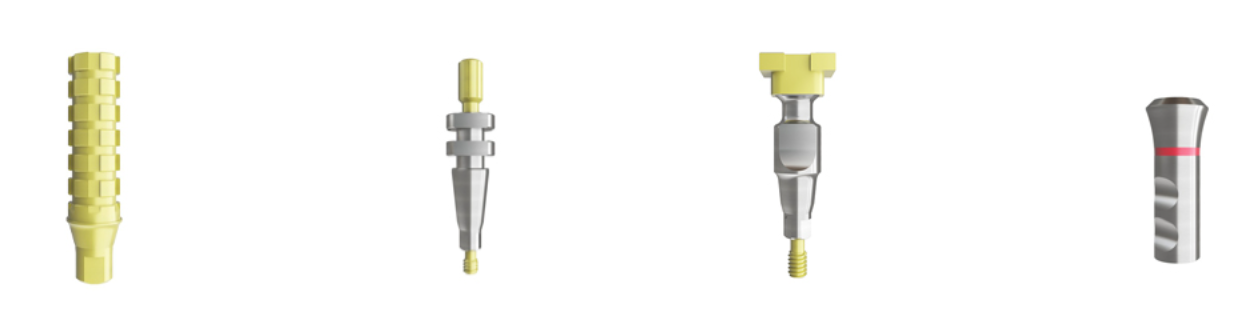
From a production standpoint, thread geometry directly impacts:
l CNC machining complexity
l Tool wear
l Surface treatment consistency
l Cost efficiency
For example:
l Square threads require more precise tooling
l Microthreads demand higher-resolution machining
l Complex hybrid threads increase inspection requirements
This is why experienced manufacturers focus not only on design but also on process control and repeatability, ensuring that thread geometry performs consistently across batches.
If you are sourcing implants or components, consider these factors:
l Developed markets often demand advanced thread designs
l Emerging markets may prioritize cost-efficiency
l Immediate loading → aggressive threads
l Esthetic zone → microthreads + fine pitch
l Soft bone → deeper, sharper threads
l Dense bone → less aggressive geometry
l Premium → complex hybrid designs
l Value segment → simpler, reliable geometries
The industry is moving toward:
l AI-optimized thread geometries
l Patient-specific implant design
l Surface + thread synergy optimization
l Additive manufacturing (3D printing) for complex threads
Thread design is no longer just mechanical—it’s becoming data-driven and biologically integrated.
There is no universal “best” type. Square and buttress threads are often preferred for load distribution, while reverse buttress designs excel in soft bone and immediate loading.
Yes. Thread geometry influences stress distribution, which directly affects bone remodeling and integration.
Not necessarily. While deeper threads improve primary stability, excessive depth can increase insertion torque and damage bone.
They help preserve crestal bone and improve long-term esthetic outcomes, especially in visible areas.
Most modern systems use hybrid designs, combining multiple thread concepts to optimize performance across different conditions.
Yes. More complex geometries require advanced machining and quality control, increasing production costs.
Implant thread design sits at the intersection of engineering precision and biological response. For B2B buyers and manufacturers, understanding these nuances is essential—not just for selecting the right product, but for building a competitive and credible offering in the dental implant market.
As the industry continues to evolve, the most successful implant systems will not rely on a single thread type, but on thoughtfully engineered combinations tailored to real clinical needs.