Time:2026-10-23 Form:本站
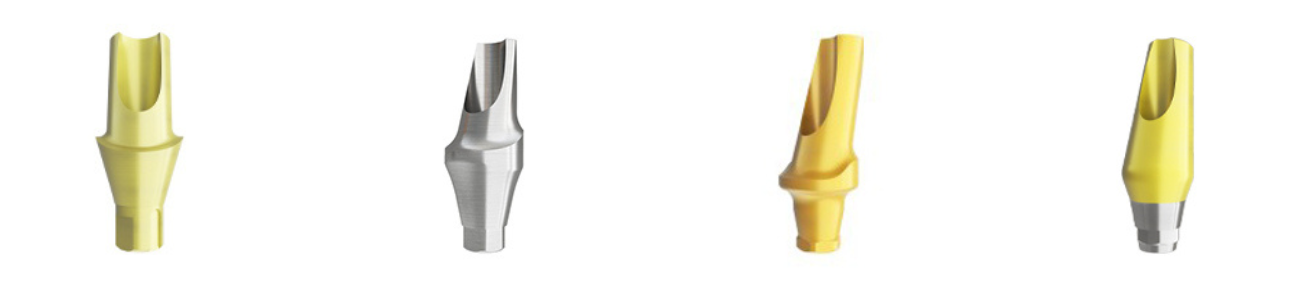
An abutment is the core component connecting a dental implant to the suprastructure prosthesis. A straight abutment follows the long axis of the implant, suitable for straightforward cases with ideal implant placement and favorable bone conditions. An angled implant abutment, by contrast, comes with a pre-set deflection angle to reorient the restorative platform and compensate for tilted implant placement.
Clinicians often have to tilt implants to avoid the maxillary sinus and inferior alveolar nerve, or place implants in sites with insufficient bone volume. Forcing a straight abutment in these scenarios may result in facial screw access openings, tilted crowns and frameworks that fail to seat properly. Angled abutments resolve such conflicts. They eliminate the need for secondary repositioning surgery and deliver angular compensation at the prosthetic stage, expanding treatment options for complex clinical cases.
Angled abutments are categorized clearly. Clinicians, dental labs and procurement teams primarily evaluate four factors for selection: angulation, structure, material and retention mechanism.
By pre-set compensation angle: Prefabricated stock abutments are commonly available in 15°, 17°, 25° and 30°. Larger angles do not equate to better performance. Greater deflection concentrates stress at the bent segment, imposing stricter requirements on machining precision and material strength. Clinically, compensation is generally limited to within 30°. CAD/CAM custom abutments are preferred for more severe tilt.
By structural design:
Prefabricated angled multi-unit abutments (MUA):
The workhorse for full-arch rehabilitation and widely used in All-on-4 and All-on-6 protocols. Standardized angled MUAs align divergent tilted implants onto a unified restorative platform to create a common path of insertion for passive seating of screw-retained frameworks.
Prefabricated single-tooth angled abutments:
For single anterior and posterior crown restorations, offered in titanium alloy and zirconia versions.
Digitally milled custom angled abutments:
Fabricated from intraoral scan data with high design freedom. Ideal for special cases featuring irregular implant angulation beyond the range of standard stock specifications.
By manufacturing material:
Titanium alloy angled abutments:
The industry mainstream. It delivers consistent strength, reliable fatigue resistance, good machinability and controlled cost, making it the first choice for posterior sites under high occlusal loading.
Zirconia angled abutments:
Features favorable biocompatibility, translucency and superior esthetic performance. However, zirconia is relatively brittle, so caution is required for high-angle applications and heavy posterior occlusal loading.
Titanium base + zirconia suprastructure hybrid abutments:
Retain the mechanical strength of the titanium connection while achieving the esthetic advantages of zirconia. A popular option for complex anterior restorations.
By retention mechanism:
Screw-retained:
Redirects the screw channel toward the lingual or occlusal surface and away from the facial/buccal esthetic zone. It facilitates crown removal, follow-up checks and maintenance, and is adopted in most full-arch restorations.
Cement-retained:
Selected when no suitable screw exit remains after angular correction. Chairside handling is simple, yet residual subgingival cement is difficult to clean, raising challenges for long-term maintenance.
| Comparison Item | Straight Abutment (0° Abutment) | Angled Abutment |
| Axial principle | Follows the implant long axis without deflection | Features a pre-set bend to redefine the restorative long axis |
| Primary indications | Ideal implant angulation and adequate bone volume | Tilted implants, constrained anatomy, divergent insertion paths of multiple implants |
| Screw channel location | Coaxial with the implant | Redirected lingually / occlusally to avoid the facial esthetic zone |
| Stress profile | Load transfers axially along the implant with even distribution | Stress concentrates at the bend; occlusal risks rise in high-angle cases |
| Representative applications | Routine single posterior crowns, bridgework with favorable bone anatomy | All-on-4 full-arch rehabilitation, tilted anterior implants, restorations in bone-deficient areas |
| Available formats | Mostly stock, limited custom options | Standard prefabricated angles + digital CAD/CAM custom abutments |
This is the most mature and highest-volume indication for angled abutments. Many edentulous patients present with severe posterior alveolar bone resorption. The posterior maxilla borders the maxillary sinus and the posterior mandible sits adjacent to the inferior alveolar nerve; vertical implant placement in these regions often involves difficult, invasive bone augmentation. The All-on-4 protocol tilts distal implants to leverage native bone and avoid extensive bone grafting.
Angled MUAs serve as the key component of this protocol, with 17° and 30° being the most common specifications. They align multiple divergently tilted implants onto one shared restorative plane.
It creates a wider anteroposterior span for enhanced framework stability and supports immediate loading, so patients can receive provisional restorations shortly after surgery.
Inventory should include multiple emergence heights matched to varying gingival thicknesses (2 mm, 3 mm, 4 mm), rather than stocking only one collar height.
The anterior region demands the highest esthetic outcomes. Following alveolar bone resorption, implants are often placed facially to achieve sufficient osseointegrated length. Pairing such implants with straight abutments exposes the screw opening on the facial surface, compromising appearance and increasing risks of screw loosening and marginal discoloration.
Angled abutments shift the screw channel lingually to conceal the access hole and enable screw-retained single anterior crowns.
Zirconia or titanium-zirconia hybrid abutments are preferred in esthetic zones to reduce metallic show-through.
Angular compensation for anterior sites should not be excessive. Steep bends complicate abutment shoulder contouring, may irritate gingiva and jeopardize long-term peri-mucosal stability.
When multiple consecutive teeth are missing, adjacent root anatomy and bone morphology restrict implant orientation, frequently resulting in divergent, non-parallel implants. Straight abutments cannot establish a unified path of insertion, preventing passive seating of fixed bridges.
Angled abutments of different angles adjust the restorative axis of each implant to achieve a common insertion trajectory.
It avoids secondary surgical repositioning of implants and shortens treatment time, suitable for elderly patients who cannot tolerate complex surgery.
Cantilever length must be carefully controlled. Stress concentration is inherent to angled abutments; extended cantilevers amplify loading and raise the risk of abutment or screw failure.
Some patients suffer from severe alveolar atrophy. Even after guided bone regeneration (GBR) or block bone grafting, the final available bone may still present unfavorable implant angulation. Older implants with suboptimal placement may also require re-prosthetic rehabilitation.
As long as osseointegration is confirmed, angled abutments provide prosthetic compensation without explanting stable implants.
Custom abutments fabricated from intraoral scans are generally recommended for such irregular tilting, as standard stock angles rarely provide an accurate match.
Pre-treatment occlusal assessment is mandatory to prevent lateral occlusal overload after delivery.
In select cases, adjacent roots lie in close proximity and osseous exostoses create obstacles, forcing mesial or distal tilting of implants. Angled abutments reorient the suprastructure so crowns align naturally with the dentition. Well-defined interproximal spaces facilitate daily hygiene and lower the incidence of peri-implantitis and interproximal caries.

Angled abutments are not universal correction devices and carry clear clinical boundaries for both clinical and procurement teams.
First verify implant interface compatibility. Internal hex, external hex and conical connections are non-interchangeable. Interface tolerances and platform heights must match the target implant system. Uncontrolled tolerances lead to microleakage and recurrent screw loosening.
Keep angular compensation within reasonable limits. Stock abutments are suitable for deviations between 15°–30°. For tilt beyond this range, forced application is not advised.
Select material according to occlusal load. Titanium alloy is prioritized for high-force posterior regions; zirconia is reserved for low-load anterior esthetic cases.
Match emergence height to gingival thickness. A shoulder positioned too high causes metallic exposure and gingival irritation; a deeply submerged shoulder complicates impression-taking and cement cleanup.
Plan retention solutions in advance. Confirm driver access for screw-retained designs. Cement-retained cases require adequate working space and strict cement removal protocols.
For dental component distributors and OEM buyers, angled abutments are a high-value niche category with inventory logic distinct from conventional straight abutments.
Adopt tiered stocking strategy. 17° and 30° angled MUAs are high-demand SKUs and should be stocked for mainstream implant systems with multiple emergence heights. Low-volume high-angle and zirconia abutments are better handled via made-to-order orders to ease inventory pressure.
Request mechanical validation documentation. The bent zone is the mechanical weak point. For compatible abutments, fatigue and torque test reports must be reviewed; visual similarity alone is insufficient for procurement.
Complete digital supporting components. Intraoral scanning workflows are widely adopted by clinics. Angled abutment packages with matching scan bodies and implant analogs improve product competitiveness.
Clarify lead time differences. Standard prefabricated abutments ship from stock, while custom milled abutments require scanning and machining with longer turnaround times. Communicate expectations clearly with downstream clients.
Q1: Are angled abutments more prone to loosening or fracture than straight abutments?
A1: When used within appropriate angulation limits, with proper occlusal design and qualified manufacturing, their long-term stability is comparable to straight abutments. Risks mostly stem from excessive angulation, long cantilevers, lateral occlusal overload or poor interface precision, rather than inherent defects of the abutment itself.
Q2: Is an angled abutment mandatory for All-on-4?
A2: Yes. The classic All-on-4 concept relies on distally tilted implants to reduce bone grafting, and angled MUAs are the core component that establishes a unified path of insertion. If all implants are placed vertically, treatment indications will be significantly narrowed.
Q3: Can zirconia angled abutments be used in posterior regions?
A3: Not recommended. Zirconia has high brittleness. Under heavy masticatory forces in posterior sites, high-angle zirconia abutments carry a markedly higher chipping risk than titanium alloy alternatives.
Q4: What is the maximum tilt that an angled abutment can compensate for?
A4: Standard stock abutments generally have an upper limit of 30°. Beyond this threshold, mechanical stress rises sharply. Custom abutments or surgical plan reassessment are recommended.
Q5: What is the most common pitfall when sourcing compatible angled abutments?
A5: Mismatched platform height and geometric tolerances of internal connections. Components may look identical visually yet leave gaps after tightening, resulting in persistent microleakage and frequent screw loosening. Cross-reference drawings and torque parameters during procurement and prioritize suppliers with verified mechanical testing.
Angled abutments are essential tools for complex rehabilitation involving tilted implants. They cannot replace straight abutments, yet they address clinical challenges arising from insufficient bone volume and restricted implant orientation. They are also the critical component enabling the widespread adoption of All-on-4 full-arch immediate rehabilitation.
Clinical application must follow clear boundaries. Avoid blindly pursuing large angular compensation and select abutments comprehensively based on occlusion, gingival condition and esthetic goals. From the supply chain perspective, these are technically sophisticated products. Customers purchase not only the component itself, but also consistent precision, supporting accessories and clear technical support. Understanding its indications and limitations allows clinicians and suppliers to leverage angled abutments properly, reduce surgical trauma and maintain long-term prosthetic stability and esthetics.