![[slide:title]](/static/upload/other/20260512/1778551853592214.webp)
![[slide:title]](/static/upload/other/20260512/1778551954982306.webp)
Time:2026-10-14 Form:本站
Dental implant restoration is not a simple surgery merely for fixture placement. Instead, it represents a systematic treatment workflow consisting of implant fixtures, prosthetic components and superstructures. Many clinics, dental laboratories and distributors only recognize implant accessories as “screws and abutments”. In reality, every prosthetic component features exclusive functions, applicable scenarios and clinical indications. Improper component selection, mixed usage of different models and scenario mismatch are the hidden root causes of gingival inflammation, marginal microleakage, screw loosening, restorative rework and long-term marginal bone loss.
Written in plain language with clear hierarchical logic, this article comprehensively breaks down mainstream categories of implant prosthetic components, core functions, clinical indications, selection distinctions and common misconceptions. Lightweight layout with paragraphs of varying lengths ensures great readability. It can serve as team training material, product popularization content and explanation material for end customers.
A complete implant restoration workflow covers four stages: soft tissue healing → impression taking & digital data acquisition → provisional restoration transition → definitive restoration placement. Each stage corresponds to dedicated components, which are non-interchangeable and functionally independent. The term “prosthetic components” commonly refers to all precision parts above the implant fixture for restoration, gingival shaping, impression taking and fixation, excluding endosseous implant fixtures and surgical instruments.
The healing abutment is the core component for second-stage surgery and gingival shaping. It is also critical to anterior esthetic outcomes and regular gingival cuff formation. Despite its seemingly simple structure, it exerts massive influence on esthetic restoration.
Straight Standard Healing Abutment: The most universal baseline option, suitable for most posterior single-tooth restorations and cases with conventional soft tissue thickness. It rapidly establishes gingival access and stabilizes gingival margin contour for general restoration scenarios with strong universality and high fault tolerance.
Narrow Neck Healing Abutment: Designed for anterior sites with narrow interdental space, interdental papilla tightening and patients with thin gingiva. It condenses interdental papilla and prevents widened gingival architecture, delivering compact and natural anterior gingival contour, an indispensable part for esthetic restorations.
Wide Neck Healing Abutment: Applied for large-diameter implants in posterior regions, broad occlusal space and cases with thick soft tissue. It adequately expands soft tissue and forms a wide, stable restorative channel to avoid crown margin compression on gingiva.
Contoured / Esthetic Healing Abutment: For anterior cases with high esthetic demands. Its special profile mimics the cervical emergence of natural teeth and guides natural gingival contouring, greatly reducing subsequent crown adjustment workload.
The sole objective of healing components is to shape gingiva, build stable gingival cuff and lay soft tissue foundation for definitive restoration. Many long-term esthetic failures stem not from crown design defects, but irreversible soft tissue damage induced by improper healing abutment selection.
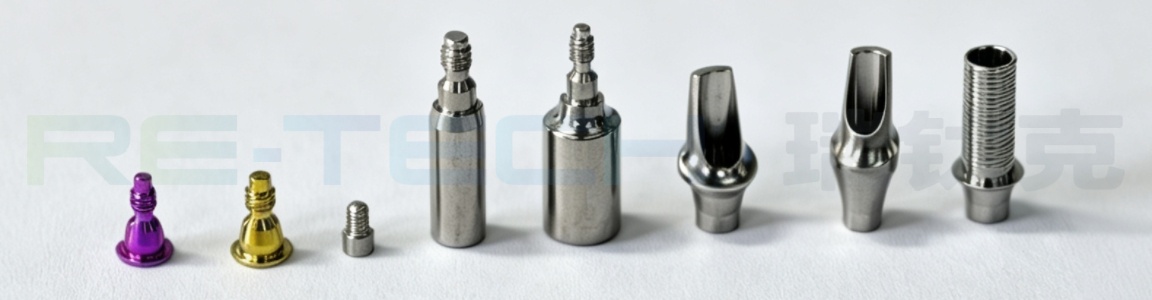
Impression-taking components feature the highest precision requirement in implant restoration and are easily overlooked, contributing to high rework rates. Whether using conventional plaster impression or intraoral scanning, the accuracy of final data fully relies on component precision.
Closed-Tray Impression Coping: Simple structure and fast operation, for single-tooth, few-unit and stable occlusion routine cases. Clinicians leave the coping intraorally during impression taking without removal, featuring high efficiency and wide clinical adoption.
Open-Tray Impression Coping: Higher fixation strength and superior positional accuracy. Ideal for multi-unit splinted crowns, fixed bridges, full-arch rehabilitation and complex cases with significant angular deviation, effectively eliminating positional errors during impression capture.
Implant Analog: Embedded inside plaster working models to replicate the intraoral implant position, angle and platform diameter at a 1:1 ratio. It acts as the benchmark for technicians to design crowns and adjust interproximal contacts and occlusion. Deviations of analog directly lead to poor seating of final restorations.
Digital Scan Body / Digital Base: Built exclusively for intraoral scanning and represents the core component in digital implant workflows. High-precision scan bodies can be accurately identified by scanners to generate authentic interface data compatible with CAD/CAM design and milling, enabling plaster-free fully digital restoration.
Scan bodies, impression copings and analogs must strictly match the system version. Old and new versions with similar appearance carry different parameters. Mixing versions causes model shift, crown marginal gaps and occlusal prematurity, resulting in batch clinical rework.
Provisional abutments and provisional restorative components are mainly used for immediate loading, immediate restoration, post-extraction immediate implantation and occlusal maintenance during transitional periods. They represent high-demand clinical accessories nowadays.
Resin Provisional Abutment: Easy to mill and polish, enabling technicians to fabricate provisional crowns quickly for short-term transitional restoration. Gentle material imposes minimal pressure on gingiva, suitable for soft tissue adaptation after immediate implant placement.
Metal Provisional Abutment: Higher strength and deformation resistance, capable of sustaining mild short-term occlusal load for transitional cases requiring extended wearing time, with superior stability over resin alternatives.
Provisional Retaining Screw: Specially engineered for provisional restorations, easy to assemble and disassemble and resistant to locking, facilitating later replacement with definitive abutments and preventing screw seizure or stripping.
Provisional implant restoration, anterior esthetic transition, edentulous transitional phase for patients and soft tissue swelling stage after surgery require provisional components. Definitive abutments cannot substitute provisional accessories.
Definitive prosthetic components bear long-term masticatory load, preserve crestal bone level and guarantee restoration service life over a decade. They form the primary product portfolio stocked by clinics and promoted by distributors.
Straight Standard Abutment: Fits most single-tooth axial implant cases, stable structure with uniform load distribution and maximum universality, the staple baseline model for definitive restoration.
Angled Abutment: For cases with tilted implant placement, limited bone volume and abnormal intraoral space. It adjusts the crown path of insertion by angle correction to resolve occlusal deviation and esthetic deficiencies.
High-Load Reinforced Abutment: Specially designed for posterior sites, heavy occlusion, molar multi-unit restorations and patients with strong occlusal force. Enhanced fatigue and deformation resistance prevent abutment distortion and screw loosening induced by long-term occlusal loading.
Solid / Hollow Prosthetic Screw: Core fastener for abutment retention, available in standard and reinforced variants. High-strength retaining screws improve interface sealing and reduce micromovement and bacterial microleakage, small yet critical for long-term stability.
CAD/CAM Abutment Blank: Used for custom abutment fabrication. Individually designed according to patient gingival morphology, bone condition and occlusal structure for advanced cases with severe bone defects, asymmetric gingiva and high esthetic requirements.

These small components are easy to neglect yet essential for refined therapy and complex case adjustment. They differentiate high-end clinics from general practices.
Healing / Cover Screw: Seals the implant fixture interface before second-stage surgery to block granulation tissue and food debris, protecting interface cleanliness.
Gingival Height Adaptation Component: Accommodates varying sulcus depths and resolves issues of over-exposed or deeply buried abutment margins caused by thick or thin gingiva.
Anti-Loosening Shim, Retention Auxiliary Parts: For high-load scenarios, full-arch rehabilitation and bruxism patients to further reduce screw loosening risk and boost restoration stability.
| Clinical Scenario | Preferred Component Combination | Core Selection Criteria |
| Anterior Esthetic Single-Tooth Restoration | Esthetic healing abutment + narrow neck definitive abutment + precision scan accessories | Prioritize soft tissue contouring, marginal adaptation and natural appearance |
| Posterior Conventional Single-Tooth Restoration | Standard healing abutment + straight abutment + regular screws | Stable durability and robust occlusal bearing capacity |
| Multi-Unit Splinted Crown / Fixed Bridge | Open-tray impression coping + high-strength abutment + reinforced retaining screws | High overall precision and anti-deformation performance |
| Immediate Implant & Immediate Restoration | Provisional abutment + provisional screws + matched healing components | Gentle transition without compression of newly formed soft tissue |
| Full-Arch Digital Restoration | Complete set of digital scan bodies + digital analogs + CAD/CAM blanks | Zero data deviation and precise version matching |
Myth 1: All abutments and screws are interchangeableSimilar appearance does not guarantee compatible parameters. Taper, thread and anti-rotation grooves differ across brands and iterative generations. Forced interchange triggers microgap, microleakage and long-term loosening.
Myth 2: Healing abutment selection is arbitrary and does not affect final outcomesGingival morphology once formed cannot be reversed. Improper selection during healing phase directly leads to black triangles and asymmetric gingival margins, resulting in esthetic restoration failure.
Myth 3: Precision of impression components matters littleImpression components serve as the source of all data. Source error will be magnified on the final crown, ranking as the leading trigger for laboratory rework and extensive clinical adjustment.
Myth 4: Provisional and definitive components can be interchangedProvisional components feature lower standards for strength, sealing and material properties. Long-term wearing easily causes deformation, microleakage and loosening and must never replace definitive restorative parts.
Q1: What is the core difference between implant prosthetic components and implant fixtures?
A: The fixture achieves osseointegration and anchorage; prosthetic components conduct gingival shaping, data acquisition, occlusal restoration and long-term fixation. The fixture determines “whether the implant can be stable in bone”, while components decide “whether the restoration can be well fabricated, esthetic and durable”.
Q2: Which component most frequently induces clinical rework?
A: Data acquisition accessories including impression copings, analogs and scan bodies. Precision deviation cannot be identified visually yet transmits errors to crowns, ranking the top hidden cause of rework.
Q3: Which component is most critical for anterior esthetic restoration?
A: Esthetic healing abutment. Soft tissue contouring lays the foundation for anterior esthetics and outweighs crown design.
Q4: Why use high-load abutments for posterior restorations?
A: Posterior occlusal force is 3–5 times higher than anterior force. Standard abutments tend to develop fatigue microdeformation under long-term loading. High-load components substantially improve long-term stability.
Q5: What components should clinics prioritize for inventory stocking?
A: Healing abutments, conventional definitive abutments, prosthetic screws and impression accessories, the four core categories covering over 90% of routine cases, delivering the most cost-effective stocking portfolio.
Though small and easy to overlook, dental implant prosthetic components represent the most precise, finely segmented and far-reaching core elements in the whole implant treatment system. From gingiva healing and contouring, accurate data capture, provisional transitional restoration to permanent occlusal loading, each category of component undertakes irreplaceable dedicated functions. No “universal all-in-one component” exists.
For dental clinics, solid mastery of applicable scenarios, selection criteria and functional differences of all components reduces rework rate from the source, improves esthetic outcomes and stabilizes long-term clinical prognosis. For distributors, systematic understanding of component portfolio forms the foundation to build professional product matrices, deliver end-user technical service and establish differentiated competitive advantages.
Against the backdrop of increasingly refined, esthetic and digital implant therapy, understanding the clinical value of every prosthetic component is an essential competency to lift clinical professionalism and supply chain competitiveness.