![[slide:title]](/static/upload/other/20260512/1778551853592214.webp)
![[slide:title]](/static/upload/other/20260512/1778551954982306.webp)
Time:2026-03-31 Form:本站
Straumann vs Nobel Biocare: A Strategic Comparison for Dental Implant Buyers in 2026
In modern implant dentistry, few comparisons are as frequently discussed as Straumann vs Nobel Biocare. These two industry leaders have shaped clinical standards, influenced treatment protocols, and defined what “premium” means in dental implantology.
For dentists, distributors, and procurement specialists, choosing between them is not simply a matter of brand recognition. It involves evaluating material science, prosthetic flexibility, digital integration, long-term clinical evidence, and—increasingly—cost efficiency.
At the same time, the global dental implant market is evolving. While legacy brands remain dominant in high-end clinical segments, a growing number of buyers are exploring alternative sourcing strategies to balance performance and scalability.
This article provides a comprehensive, technical, and commercial comparison of Straumann and Nobel Biocare, along with a broader perspective on how implant sourcing decisions are changing in today’s competitive landscape.
Straumann is widely recognized for its emphasis on material science and surface technology. Headquartered in Switzerland, the company has built its reputation through:
1. Proprietary materials such as titanium-zirconium alloys
2. Advanced surface treatments designed to accelerate osseointegration
3. Long-term clinical studies supporting implant survival rates
Straumann’s philosophy centers on predictability, efficiency, and biological performance, making it particularly attractive for clinicians who prioritize consistency in everyday procedures.
Nobel Biocare has a deep historical connection to the development of modern implantology. Its approach is characterized by:
l Strong integration with digital dentistry workflows
l Extensive prosthetic options for complex restorations
l Early adoption of CAD/CAM and guided surgery technologies
Rather than focusing primarily on materials, Nobel Biocare emphasizes restorative versatility and treatment planning flexibility, which is especially valuable in advanced or aesthetic cases.
One of the most critical differences between Straumann and Nobel Biocare lies in how they approach implant design and surface engineering.
Straumann has invested heavily in developing materials that go beyond traditional titanium. Its innovations aim to:
l Improve mechanical strength
l Support reduced-diameter implants
l Accelerate healing time
Its surface technologies are designed to enhance early-stage osseointegration, which can be particularly beneficial in cases requiring faster loading protocols.
Nobel Biocare focuses on creating surfaces that promote stable and predictable bone integration over the long term. Its implant systems are engineered to:
l Encourage consistent bone growth
l Maintain stability across different bone densities
l Support long-term clinical success
While less focused on new material types, Nobel Biocare’s strength lies in refinement and reliability.
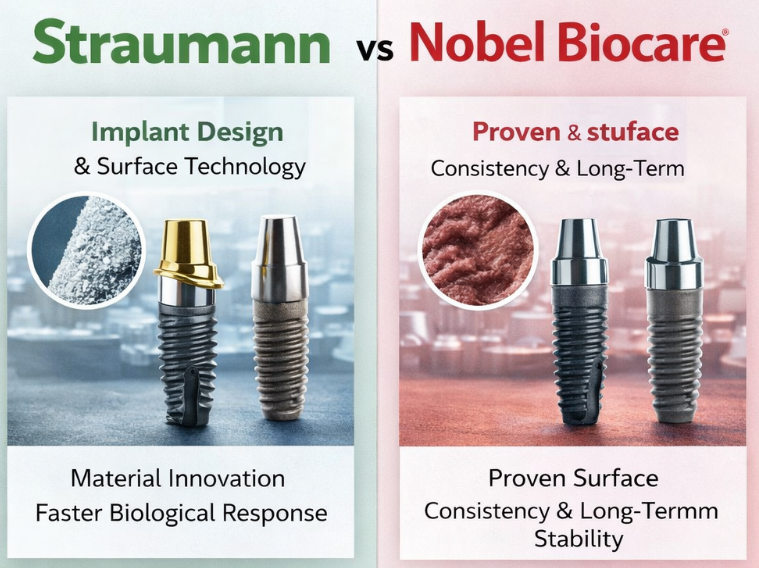
l Straumann: material innovation and faster biological response
l Nobel Biocare: proven surface consistency and long-term stability
For many clinicians and labs, prosthetic options are just as important as the implant itself.
Straumann’s system is designed with simplicity and efficiency in mind:
l Streamlined component selection
l Standardized workflows
l Reduced chair time in routine cases
This makes it highly suitable for clinics that prioritize operational efficiency and repeatability.
Nobel Biocare offers a more extensive prosthetic ecosystem, including:
l Multiple abutment designs
l Greater flexibility in restorative approaches
l Advanced solutions for complex and full-arch restorations
This flexibility allows clinicians to adapt treatment plans more freely, especially in challenging cases.
l Straumann: optimized for standardized workflows
l Nobel Biocare: optimized for customization and complexity
Digital workflows are now central to implant dentistry, influencing both clinical outcomes and operational efficiency.
Nobel Biocare has historically been a leader in digital integration:
l Comprehensive treatment planning tools
l Strong CAD/CAM ecosystem
l Seamless workflow from diagnosis to restoration
Straumann has rapidly expanded its digital capabilities in recent years:
l Integrated scanning and planning solutions
l Growing partnerships in digital dentistry
l Competitive end-to-end workflow offerings
While both companies now offer robust digital ecosystems, Nobel Biocare still maintains a slight advantage in prosthetic-driven digital workflows, whereas Straumann continues to strengthen its position.
Both Straumann and Nobel Biocare are supported by extensive clinical research.
l Straumann is often associated with high survival rates and strong material performance
l Nobel Biocare is known for long-term clinical documentation and historical reliability
From a market perspective, both brands benefit from:
l Strong global recognition
l Established distribution networks
l High levels of clinician trust
Despite their strengths, both brands share a common challenge: cost.
Premium implant systems typically involve:
l High unit pricing
l Expensive prosthetic components
l Significant investment in inventory
For many distributors and dental groups, this creates constraints:
l Reduced profit margins
l Limited accessibility in price-sensitive markets
l Slower scalability for large-volume operations
In recent years, procurement strategies have begun to shift.
Instead of relying exclusively on premium brands, many buyers are adopting a more balanced approach—evaluating not only clinical performance, but also:
l Supply chain efficiency
l Cost control
l Customization capabilities
This has led to increased interest in OEM (original equipment manufacturer) dental implant solutions.
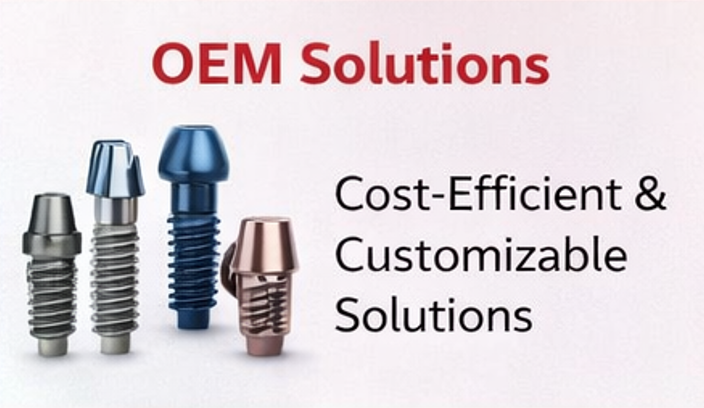
In recent years, some advanced OEM manufacturers have begun to gain attention among global distributors and dental groups. Companies such as RE-Tech, for example, focus on precision manufacturing, stable quality control, and scalable supply capabilities tailored for B2B buyers.
Rather than competing directly on branding, these manufacturers emphasize production efficiency, customization, and cost optimization. This makes them particularly relevant for organizations looking to build private-label implant systems or expand into price-sensitive markets while maintaining consistent product quality.
OEM manufacturers produce implants that may be:
l Sold under private labels
l Customized for specific markets
l Designed for compatibility with existing systems
Modern OEM production has advanced significantly, often incorporating:
l High-precision CNC machining
l Strict quality control processes
l International manufacturing standards
As a result, OEM implants are no longer viewed solely as low-cost alternatives, but as strategic tools for business growth.
OEM systems typically reduce:
l Manufacturing overhead
l Branding and marketing costs
l Distribution layers
This enables more competitive pricing and improved margins.
Unlike fixed brand ecosystems, OEM solutions allow:
l Custom implant designs
l Private labeling
l Market-specific adaptations
For distributors and large clinics, scalability is essential. OEM manufacturers often provide:
l Flexible order volumes
l Stable production capacity
l Faster turnaround times
Important Considerations
While OEM solutions offer clear advantages, buyers should also evaluate:
l Brand recognition in their target market
l Availability of long-term clinical data
l Regulatory compliance in different regions
A balanced assessment is essential to ensure both clinical reliability and commercial success.
Factor | Straumann | Nobel Biocare | OEM Solutions |
Brand Recognition | Very High | Very High | Varies |
Price Level | High | High | Competitive |
Clinical Evidence | Extensive | Extensive | Growing |
Flexibility | Limited | Moderate | High |
Customization | No | Limited | Strong |
Margin Potential | Lower | Lower | Higher |
The best choice depends on your business model and market positioning.
If your focus is on:
l High-end clinical positioning
l Maximum brand trust
l Complex or aesthetic cases
Then premium systems like Straumann or Nobel Biocare remain strong choices.
If your priorities include:
l Expanding into competitive markets
l Improving cost efficiency
l Building your own brand
Then OEM solutions can offer significant advantages.
Many successful distributors and clinics now adopt a hybrid approach:
l Premium implants for flagship or complex cases
l Cost-efficient systems for routine procedures
This allows for both clinical flexibility and financial optimization.
No. Each system has its own implant connections and prosthetic components, which are not interchangeable.
Straumann is often preferred for its simpler workflow, while Nobel Biocare may require more familiarity due to its broader prosthetic options.
Costs are influenced by:
l Research and development
l Clinical studies
l Brand positioning
l Global distribution networks
Many OEM implants meet international quality standards. However, buyers should carefully evaluate manufacturer credentials and certifications.
Yes. Many clinics use multiple systems to balance cost, flexibility, and patient needs.
Straumann and Nobel Biocare continue to set benchmarks in the dental implant industry, each excelling in different areas—from material innovation to restorative flexibility.
However, the market is no longer defined solely by legacy brands. As procurement strategies evolve, buyers are increasingly considering a broader range of solutions that align with both clinical requirements and business objectives.
Ultimately, the most effective approach is not about choosing a single “best” system, but about understanding how different options can be strategically combined to support long-term growth, efficiency, and patient outcomes.