![[slide:title]](/static/upload/other/20260512/1778551853592214.webp)
![[slide:title]](/static/upload/other/20260512/1778551954982306.webp)
Time:2026-09-23 Form:本站
Within the dental implant supply chain, OEM custom components have become a core solution for dental distributors, chain clinics and dental laboratories to control procurement costs and optimize inventory structures. While original implant components deliver stable precision and high clinical safety, they generally come with premium pricing, extensive SKUs, high minimum order quantities, long lead times and frequent stockouts. Large-scale long-term stocking will heavily tie up working capital and warehousing resources. In contrast, low-end OEM components on the market carry ultra-low unit prices yet suffer from excessive interface tolerances, large batch variations, substandard raw materials and chaotic version compatibility issues. These defects easily lead to clinical rework, screw loosening, gingival inflammation and patient complaints, generating substantial hidden costs. Therefore, the core challenge of OEM procurement always lies in striking an accurate balance between cost control and product reliability. From a practical perspective, this article systematically breaks down how to achieve cost-effective procurement of implant OEM components without compromising clinical safety.
Most buyers judge OEM products merely by appearance and hand feel, assuming identical visual features guarantee universal compatibility. In fact, dental implant components are micron-level precision medical devices whose reliability is determined by a full set of mandatory specifications, forming the non-negotiable quality baseline for procurement.
The interface is the lifeline of implant components. Tapered connections, internal hex anti-rotation structures and platform-switching designs of mainstream implant systems adopt closed-loop precision parameters from original manufacturers. Tolerances for taper angle, thread pitch, anti-rotation slot depth and platform diameter are controlled at the micron level. Tiny deviations invisible to the naked eye can cause pseudo-seating, poor interface adaptation and eccentric occlusal loading. In the short term, they result in seating obstruction and premature occlusal contacts. Long-term micromotion and microleakage will directly trigger common complications including screw loosening, peri-implant inflammation and marginal bone resorption. Qualified OEM manufacturers fully replicate parameters referencing original specifications, whereas low-cost OEM suppliers only copy outer contours with notable deviations in core dimensions.
The intraoral environment features constant moisture, complex flora and continuous occlusal loading, imposing stringent requirements on material performance. Compliant clinical-grade OEM components are uniformly manufactured from medical Grade 5 titanium alloy Ti-6Al-4V ELI, boasting high material purity, outstanding corrosion resistance, fatigue resistance and biocompatibility for stable long-term intraoral service. To cut costs, low-end OEM suppliers often use industrial-grade titanium or recycled remelted materials containing excessive impurities, insufficient structural strength and risk of oxidative precipitation. Long-term use may lead to abutment deformation, screw fracture, gingival darkening and inflammation.
A qualified sample does not guarantee stable bulk production, which represents the biggest hidden pitfall in OEM procurement. Samples can be manually refined and screened, while mass product quality fully depends on equipment precision, tooling fixtures, standardized processes and batch sampling inspection systems. Factories lacking quality control suffer from batch-to-batch fluctuations in taper, thread tightness and platform dimensions for the same model. This causes intermittent product failure, random clinical incidents and heavy after-sales losses. Premium industry suppliers such as RE-TECH conduct dimensional calibration, torque testing and marginal fit verification batch by batch, strictly limiting batch deviations to ensure uniform mass supply.
Mirror polishing, passivation for corrosion protection and screw nitriding hardening directly determine component service life and soft tissue compatibility. Fine polishing reduces plaque accumulation and lowers inflammation risks; passivation enhances corrosion resistance; nitriding stabilizes the friction coefficient of threads for precise locking torque, resisting thread stripping even after repeated disassembly and tightening. Low-cost OEM suppliers commonly simplify these processes, leaving machining burrs and rough surfaces that tend to trap plaque and irritate gingiva, greatly elevating clinical risks.
Dental consumables fall under Class II medical devices, where compliance and traceability form the operational bottom line. Authorized OEM manufacturers can provide material certificates, dimensional inspection reports, biocompatibility documentation and batch traceability records to meet quality control and regulatory audit requirements for clinics. Unqualified low-cost OEM suppliers offer no technical documentation, bringing not only clinical hazards but also compliance risks.
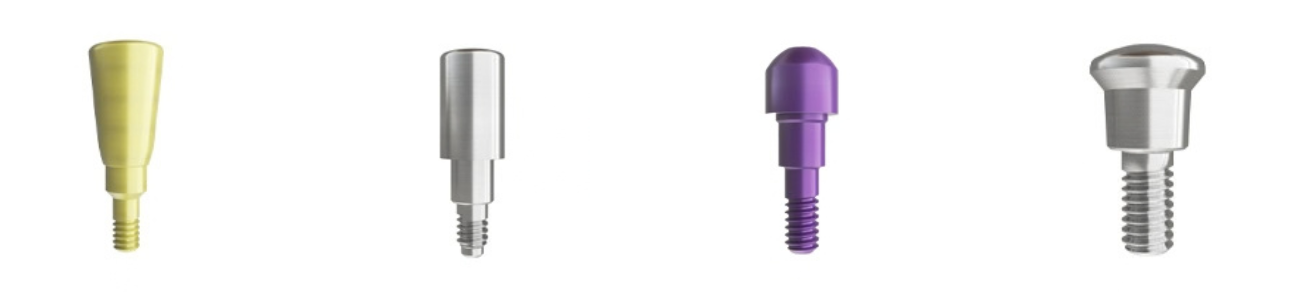
To balance cost and reliability, buyers must move beyond simple price comparison and clearly separate costs that cannot be reduced from those eligible for optimization, enabling targeted cost reduction without crossing quality boundaries.
Raw material cost (absolutely non-negotiable): Medical titanium forms the foundation of clinical safety. The primary cost-cutting tactic of low-end OEMs is substituting non-medical raw materials, directly sacrificing product reliability. No compromise shall be made on this item for lower pricing.
Precision machining cost (optimizable under control): High-precision 5-axis CNC machining requires longer working hours and delivers superior accuracy. Yet standardized mass production and optimized tooling workflows can cut processing premiums without downgrading quality.
Quality inspection cost (mandatory risk-prevention cost): Dimensional sampling, torque testing and marginal fit verification guarantee batch stability. Removing inspection procedures may reduce prices but lead to bulk defective goods and catastrophic after-sales consequences, which is not cost-effective.
Iteration and technical service cost (long-term hidden value): Top-tier manufacturers continuously track version iterations of implant systems, update CAD databases and provide technical adaptation guidance. Although this seemingly raises costs, it substantially reduces long-term losses caused by adaptation failure and model obsolescence.
Order scale cost (flexibly adjustable): Unit prices are higher for small-batch customization and lower for mass production. Reasonably planned tiered stocking can dilute manufacturing costs.
The comparison across multiple dimensions clearly illustrates risks, costs and applicable scenarios for the three product categories, delivering intuitive reference for procurement selection:
| Evaluation Dimension | Original Brand Components | Compliant Clinical-Grade OEM Components | Low-End OEM Components without QC |
|---|---|---|---|
| Interface Adaptation Precision | Micron-level gap-free fit with stable compatibility | Parameters referenced to original standards, controllable tolerances, no micromotion | Wide tolerance fluctuation, pseudo-fitting commonly seen |
| Material Reliability | Medical-grade titanium with full traceability | Medical raw materials with complete batch reports | Industrial scrap/recycled materials, no traceability |
| Batch Stability | Extremely high, no batch variation | Stable with minimal batch differences | Highly volatile; inconsistency between samples and bulk goods |
| Procurement Unit Price | High with heavy premium | Moderate, optimal cost-performance | Extremely low, no quality assurance |
| Iteration & After-sales Support | Slow iteration, long lead times, cumbersome after-sales | Continuous iteration, comprehensive technical support | No iteration, no after-sales or technical service |
| Applicable Scenarios | Full-arch reconstruction, high-difficulty esthetic restorations | 90% of routine clinical restorations and bulk stocking | Model teaching only, prohibited for clinical use |
The core logic for balancing cost and quality lies in risk prevention in advance, graded management and targeted cost reduction, cutting invalid premiums while safeguarding safety baselines.
Before procurement, document all technical parameters in writing, including compatible brands, system models, old & new versions, interface types, platform specifications, standard torque, surface treatment and digital adaptation requirements. Clear parameter standards prevent non-standard production and arbitrary price hikes by suppliers, and support quotation comparison among multiple vendors for identical specifications, effectively eliminating extra costs from vague quotations.
Never place large orders directly. First, verify engineering drawings to confirm the supplier masters accurate original parameters. Second, conduct physical assembly testing to check passive seating, marginal fit and screw torque for gaps or wobbling. Third, validate version compatibility to confirm the supplier can distinguish iteration differences between new and old implant systems and eliminate hidden adaptation risks. Low-cost sample verification avoids huge losses caused by defective bulk shipments.
Implement graded inspection items to balance safety and cost. Mandatory baseline items that cannot be downgraded include interface tolerances, medical raw materials, batch consistency and assembly marginal fit. Optimizable items include outer packaging style, minor cosmetic details and reuse of non-critical test reports, where costs can be flexibly reduced. Agree on sampling ratios and return & replacement policies for defective products with suppliers in advance to lock risk boundaries.
Large-quantity procurement yields lower unit prices but may result in overstocking and model obsolescence; small-batch replenishment offers flexibility yet higher unit costs. The optimal strategy is tiered trial orders: start with small trial batches to verify stable quality, gradually expand orders after confirming proper compatibility, and combine orders of similar models to share fixture setup costs. This captures mass-production pricing advantages while avoiding bulk risks and improving inventory turnover.
A one-time low price does not equal long-term savings. A supplier’s iteration capability, batch quality stability and efficiency of technical service directly determine long-term operating costs. Prioritize OEM factories specializing in dental precision components with independent machining capacity and complete QC systems that can synchronize with system updates. Long-term cooperation secures stable quotations, on-demand delivery and continuous technical support, drastically cutting after-sales losses and iteration costs.

Over-reliance on sample quality, assuming qualified samples guarantee stable bulk production and ignoring batch fluctuation risks in mass manufacturing.
Judging precision by appearance and believing visual similarity enables clinical compatibility while overlooking micron-level tolerance hazards.
Pursuing the lowest price blindly and ignoring hidden costs such as rework, customer complaints and reputational damage.
Confusing industrial OEM and clinical OEM, misapplying non-clinical model components and creating medical safety hazards. Avoiding these pitfalls forms the foundation of refined procurement management.
Q1: Can compliant OEM components replace original components for clinical use?
A: For most standardized cases including routine single-tooth restorations, simple bridgework and secondary healing, compliant OEM components meet clinical requirements in precision, stability and safety, offering remarkable cost-performance advantages. Original components are only recommended for high-risk cases such as full-arch reconstruction, heavy occlusal loading and demanding anterior esthetic restorations as a safety backup.
Q2: Which quality indicators must not be compromised during cost reduction?
A: Five core indicators are non-negotiable: medical-grade raw materials, precision interface tolerances, batch consistency, version differentiation capability and product traceability. Packaging, minor cosmetic features and non-critical test items can be flexibly optimized for cost savings.
Q3: How to quickly verify reliable quality control of an OEM manufacturer?
A: Request material certificates, batch dimensional sampling data and quality control records to verify authentic traceability. Meanwhile confirm the factory has stable iteration capability and standardized QC workflows to maintain consistent batch quality over the long run.
Q4: What is the optimal stocking model for dental distributors?
A: Adopt a stocking structure dominated by compliant OEM components supplemented by original parts. Use cost-effective OEM products to cover 80%-90% of routine cases, and stock a small quantity of original components for high-difficulty, high-risk cases to balance profit, inventory and clinical safety.
The essence of procurement for dental implant OEM components is not a binary choice between low pricing and high quality. Instead, it achieves dynamic balance between cost and reliability through standardized and refined procurement management. Original components carry high premiums and heavy inventory pressure, while low-end OEM products have uncontrollable risks and substantial hidden costs. Clinical-grade OEM components with formal QC, precise parameters and stable iteration capability represent the optimal solution for oral B2B procurement at present. Adopt five practical strategies: define standardized requirements, pre-verify samples, implement graded QC, arrange tiered stocking and build long-term supplier partnerships. These measures cut invalid premiums, reduce operating costs and lower after-sales risks while safeguarding clinical safety. Moving past crude price comparison and establishing refined procurement systems with upfront risk control is key for dental distributors and chain clinics to achieve long-term profitability and stable operations.