![[slide:title]](/static/upload/other/20260512/1778551853592214.webp)
![[slide:title]](/static/upload/other/20260512/1778551954982306.webp)
Time:2026-09-21 Form:本站
Within the dental implant industry, most procurement specialists, dental distributors and oral institutions focus primarily on implant fixtures while overlooking the importance of restorative components. However, reviews of actual clinical rework cases and post-treatment complications reveal that the vast majority of issues, including screw loosening, marginal microleakage, recurrent gingival inflammation, long-term marginal bone resorption and poor restoration seating, do not stem from surgical errors. Instead, they arise from procurement-side hazards such as poorly matched restorative parts, insufficient precision, inconsistent batch quality and mismatched parameters.
For B2B purchasers, dental implant restorative components are not ordinary low-value consumables, but core precision parts that determine the long-term stability of restorations. Mixed use of multiple implant brands has become commonplace in the market. The single-brand original-equipment stocking model suffers from excessive SKUs, heavy inventory pressure, long lead times and difficult replenishment. High-quality compatible components have evolved into the mainstream stocking solution for the industry. Nevertheless, quality varies widely across the compatible component market. If procurement decisions rely merely on visual appearance and price comparison, bulk clinical risks are highly likely. This article systematically explains standardized procurement criteria for implant restorative components across eight dimensions: fitting performance, precision, materials, dual-workflow compatibility, quality control, supply chain, compliance and cost. The content is practical, professionally neutral and suitable for publication on overseas Chinese-language websites.
Implant components are micron-level precision mating parts. Fitting performance takes priority over price and brand. A typical misconception among purchasers is that visual similarity and manual screw-in capability equal proper fitting. In fact, internal taper, groove depth, threads and platform tolerances cannot be identified visually. False fitting shows no abnormalities in the short run, but inevitably causes interface micromotion, microleakage and loosening over time.
Three major categories of implant interfaces dominate the current market: internal hex anti-rotation interfaces, Morse taper internal connection interfaces, and platform-switching interfaces. The internal hex structure delivers robust stability and is widely used for conventional single-tooth restorations. The taper self-locking structure provides superior sealing and strong resistance to microleakage, commonly adopted for premium implant systems and immediate loading cases. The platform-switching structure effectively reduces marginal bone resorption and demands extremely high precision for component shoulder dimensions. The three interface types operate on fundamentally different structural principles and cannot be interchanged. Procurement teams must first confirm the interface type before selecting specific models.
All mainstream implant brands continuously adjust internal parameters. New and old implant versions look nearly identical externally, yet fine adjustments are made to taper angles, thread pitch, anti-rotation groove depth and platform dimensions, rendering old and new components incompatible. Many low-cost compatible components on the market use universal molds without version differentiation, carrying extremely high fitting risks. To address system version iterations, RE-TECH consistently tracks updated data from major brands, conducts independent parameter calibration, model classification and compatibility archiving for new and old versions. This eliminates hazards from cross-version misuse at the source and guarantees clinical stability for bulk shipments.
Implant platforms are categorized as narrow, standard, wide and platform-switching platforms. Platform diameter directly controls restoration marginal adaptation, gingival support morphology and occlusal force-bearing area. An oversized platform tends to compress gingiva, triggering gingival recession and bone resorption; an undersized platform results in weak restoration margins prone to porcelain fracture and poor sealing. Procurement stocking should reasonably allocate specifications according to the composition of end-user clinical cases to prevent clinical rework caused by specification mismatches.
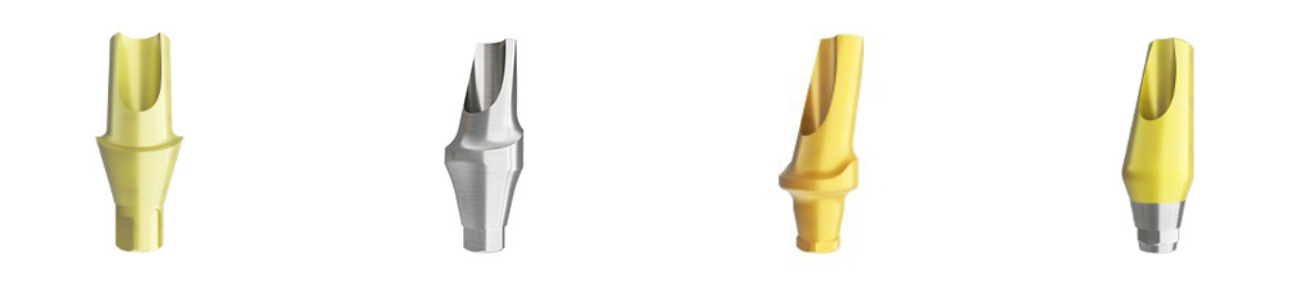
Long-term failure of implant restorations mostly originates from micron-level tolerance deviations. Repeated cyclic masticatory loading continuously amplifies tiny gaps, eventually leading to screw loosening, interface leakage and aggravated bone resorption. Therefore, component machining precision, coaxiality, fitting accuracy and thread precision are mandatory hard indicators to verify during bulk procurement.
During sample testing and procurement acceptance, four key metrics must be inspected: taper fitting tolerance, anti-rotation groove positioning tolerance, thread profile precision and overall coaxiality. Taper fitting governs sealing performance; positioning tolerance ensures stable, rotation-free abutment seating; thread precision controls torque stability and fatigue resistance; coaxiality prevents eccentric loading of restorations. Combined, these four parameters determine the long-term service life of restorations.
Many purchasers assume original components are superior to compatible alternatives. In reality, quality differences depend on processing equipment and quality control systems rather than brand classification. High-quality compatible components can fully match the precision of original parts, while low-end generic products only replicate outward appearance with substantial internal parameter errors.
| Evaluation Dimension | OEM Brand Components | High-Quality Compliant Compatible Components | Low-End Generic Compatible Components |
| Interface Tolerance Control | Micron-level closed-loop tolerance, tight fitting | Benchmarked against OEM standards, no interface micromotion | Large tolerance fluctuation with obvious assembly clearance |
| Torque Stability | Minimal torque attenuation after repeated assembly and disassembly, high stability | Compliant standardized torque, clinically reliable | Erratic torque, prone to thread stripping and loosening |
| Version Differentiation Capability | Complete identification of iterative versions | Precise compatibility classification for new and old versions | No version distinction, high universal-adaptation risks |
| Batch Consistency | Stable mass production with minimal variation | Strict batch sampling inspection, uniform quality | Large inter-batch differences, inconsistent clinical performance |
Implant components operate long-term within the oral environment, immersed in saliva, exposed to complex flora and subjected to repeated loading. Material quality directly dictates corrosion resistance, fatigue resistance and soft tissue compatibility. Components made from industrial-grade materials, with poor polishing and no anti-corrosion treatment show no visible defects in the short term, but may cause metal ion precipitation, corrosion and discoloration, and irritate gingival inflammation over time.
Titanium Alloy Grade 5 is widely adopted for primary clinical restorative components due to its high strength, corrosion resistance and fatigue resistance. It is suitable for core load-bearing parts including abutments, screws, scan bodies and implant analogs. Pure titanium may be used for temporary restorations for enhanced ductility. Zirconia can be selected for anterior aesthetic restorations to avoid metal show-through, yet zirconia has high brittleness and is not recommended for high-load posterior regions. Procurement must verify material test reports and block non-medical raw materials from entering inventory.
Premium components undergo mirror polishing, passivation anti-corrosion treatment and screw nitriding hardening. Smooth surfaces reduce plaque accumulation and improve gingival adaptation. Nitriding stabilizes thread friction coefficients to deliver precise locking torque and resist thread stripping after repeated assembly and disassembly. Low-grade components feature burrs, rough polishing and sharp thread edges, leading to markedly higher clinical failure rates.

Contemporary dental practice uses traditional impression-taking alongside digital intraoral scanning. High-quality components must support both workflows, enabling a single inventory to cover all restoration scenarios, reduce redundant SKUs and improve inventory turnover efficiency.
Transfer copings and implant analogs must precisely replicate the three-dimensional position, angle and depth of implants, with passive seating free of clearance, rocking or jamming. Positioning deviations in components distort gypsum models, directly resulting in excessive restoration marginal gaps, premature occlusal contacts and seating difficulty, which triggers rework.
Digital components require not only physical interface matching but also supporting CAD databases that are accurate and updated in real time. Many low-cost scan bodies look similar externally but feature outdated digital model parameters, creating the issue of "physically mountable yet data inaccurate". This causes intraoral scanning modeling deviations and unmilled restorations that fail to seat. When sourcing digital components, purchasers must confirm the supplier maintains a complete database system compatible with mainstream devices.
Most purchasers only evaluate sample quality while ignoring mass-production consistency. Samples can be manually screened and refined, whereas mass production relies on equipment precision and quality control systems. Components with heavy batch variation bring random rework with inconsistent performance, severely damaging end-customer reputation.
Unstable batches lead to mixed outcomes: some units seat smoothly, some jam and some exhibit poor marginal closure. This increases return-and-replacement costs, consumable waste and after-sales burdens. Formal mass production requires five core procedures: raw material sampling inspection, first-article testing, in-process patrol inspection, finished-product full inspection and batch sample retention. RE-TECH conducts dimensional verification, torque testing, marginal fitting inspection and data recheck for every batch, strictly controlling batch errors to sustain stable long-term supply.
The biggest drawback of OEM components is an enormous number of SKUs, heavy inventory pressure, long lead times and frequent stockouts, which fail to meet market demand for multi-system workflows. High-quality compatible components use a small set of SKUs to cover multiple implant brands, enabling lightweight inventory, high turnover and low stagnant stock risk. Meanwhile, in-stock reserves, rapid replenishment and continuous database updates effectively resolve unstable OEM supply, meeting clinic demands for emergency restorations, rush impressions and follow-up visits.
Implant restorative components are Class II precision consumables. Procurement must verify full qualification documentation, including material reports, biocompatibility reports, quality control files and batch traceability records to ensure compliant and traceable products. In addition, qualified suppliers deliver technical support such as compatibility guidance, version consultation, digital data updates and troubleshooting for clinical issues, greatly lowering procurement after-sales pressure.
Procurement cost assessment cannot rely solely on unit price; both explicit and implicit costs must be considered. Low-cost components appear economical, yet rework, customer complaints, consumable waste, reputational damage and manual after-sales work generate extremely high hidden costs. OEM components deliver stable quality yet carry high overall operating costs; generic products entail high risks and frequent after-sales cases. High-quality compatible components balance precision, stability, low pricing, lightweight inventory and low rework rates, making them the mainstream B2B procurement solution with optimal cost performance and minimal risk.
Q1: Are compatible components less stable than OEM parts?
A: Not necessarily. Component stability depends on parameter precision, material, quality control and version differentiation rather than OEM status. Qualified compatible components satisfy long-term stability requirements for most conventional restorations. OEM components are recommended only for highly complex full-arch reconstructions and extreme aesthetic cases.
Q2: What is the most overlooked hidden risk in procurement?
A: Iterative differences between system versions. New and old implants look identical but have different parameters. Generic components without version differentiation create hidden gaps that induce micromotion, microleakage and bone resorption over time.
Q3: How to mitigate quality risks when purchasing compatible components in bulk?
A: Cross-check compatibility lists, distinguish system versions, test seating and torque with samples, verify qualifications and batch QC, and proceed with bulk procurement only after stability is confirmed.
Q4: What differentiates procurement of digital components from traditional components?
A: Traditional components only require physical fitting. Digital components demand dual matching of physical hardware and databases; mismatched data causes rework across the entire digital workflow.
Q5: What is the optimal stocking model for distributors?
A: Prioritize compatible components, supplemented by OEM components. Use compatible parts to cover 80% of routine cases and reserve OEM components for high-difficulty, high-risk cases to balance cost and safety.
Procurement of dental implant restorative components constitutes a systematic risk-control and operational workflow instead of simple price comparison. Purchasers must establish standardized selection logic across interface fitting, version differentiation, machining precision, medical materials, dual-workflow compatibility, batch consistency, supply chain delivery, compliance & after-sales, and comprehensive cost. OEM components are stable yet costly, inventory-heavy and slow to deliver. Low-end generic components are cheap but high-risk with frequent rework. High-quality compatible components with precise parameter calibration, version classification and rigorous QC deliver lightweight inventory, stable supply and low rework rates while safeguarding clinical safety, achieving optimal overall cost performance. With a standardized procurement framework and stable supply chain, dental distributors and institutions can effectively reduce clinical hazards, cut operating costs and improve overall service and competitiveness.