![[slide:title]](/static/upload/other/20260512/1778551853592214.webp)
![[slide:title]](/static/upload/other/20260512/1778551954982306.webp)
Time:2026-04-17 Form:本站
Behind the Scenes of Dental Implant Production: From Raw Material to Clinical Precision
For clinics, distributors, and OEM partners, dental implants are more than just medical devices—they are long-term commitments to patient outcomes, brand reputation, and regulatory compliance. Yet, most discussions in the market focus on surface-level comparisons such as implant design or price, leaving a critical question underexplored:
What actually happens behind the scenes of implant production?
Understanding the manufacturing process is not just a technical curiosity—it is a strategic advantage. For B2B buyers, knowing how implants are made allows you to evaluate suppliers more effectively, reduce risk, and ensure consistency across batches.
This article takes you deep inside the implant production pipeline—from raw material selection to final packaging—while highlighting the often overlooked factors that separate commodity products from truly reliable systems.
Every high-performance dental implant begins with the right material. In modern implantology, commercially pure titanium (Grade 4) and Ti-6Al-4V ELI (Grade 23) dominate the market due to their exceptional biocompatibility and mechanical strength.
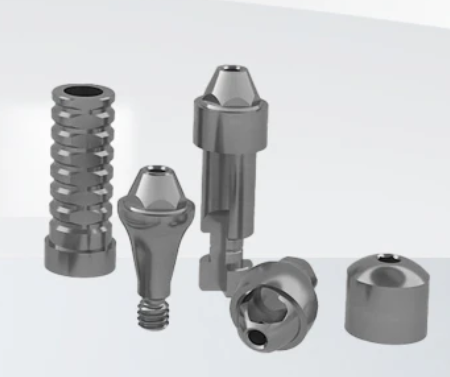
However, not all titanium is created equal.
Key Factors in Material Selection
l Purity level and interstitial elements (O, N, H)
l Microstructure consistency
l Traceability to certified mills
l Compliance with standards (ASTM F67, ASTM F136, ISO 5832 series)
For B2B buyers, one critical but often overlooked distinction is medical-grade vs industrial-grade sourcing. Even when chemical compositions appear similar, differences in melting processes (e.g., VAR vs EBM) can significantly affect fatigue resistance.
Insight:
A reliable manufacturer will not only specify the material grade but also provide mill certificates and batch traceability, ensuring full transparency throughout the supply chain.
Once raw titanium bars are approved, they enter the CNC machining stage, where implants are shaped into their final geometry.
Dental implants require micron-level tolerances, especially in:
l Thread geometry
l Internal connection systems (e.g., hex, conical)
l Platform switching interfaces
Even minor deviations can result in:
l Poor primary stability
l Micro-movements at the abutment interface
l Increased risk of peri-implantitis
Modern implant manufacturers rely on:
l Swiss-type CNC lathes for high precision
l Multi-axis machining for complex geometries
l Automated tool monitoring systems
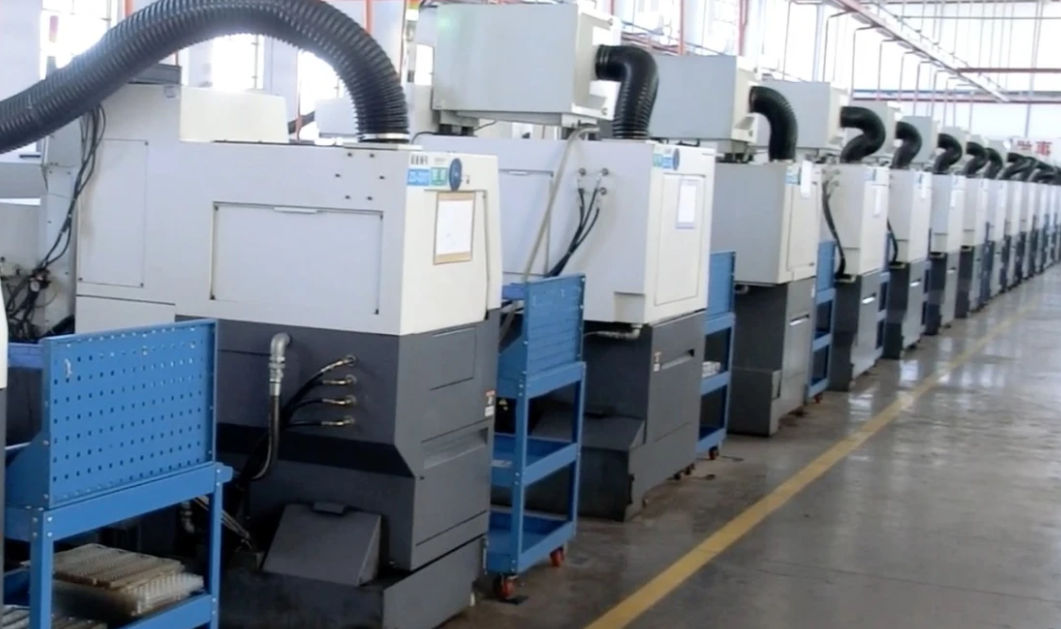
Compared to low-end production setups, advanced facilities maintain:
l Tighter tolerances
l Better surface consistency before treatment
l Lower rejection rates
B2B Perspective:
If a supplier cannot clearly explain their machining tolerances or inspection methods, it is a red flag—regardless of pricing advantages.
Surface treatment is arguably the most critical stage in implant production, directly influencing how well the implant integrates with bone.
Method | Description | Advantages | Limitations |
Sandblasted | Roughening with abrasive particles | Improved surface area | Inconsistent microstructure |
Acid-etched | Chemical etching for micro-roughness | Enhanced osseointegration | Sensitive to process control |
SLA (Sandblasted + Acid-etched) | Combination method | Industry standard | Requires strict quality control |
Anodized | Electrochemical oxidation | Bioactive surface | Higher cost |
Many manufacturers claim to use “SLA” or “advanced surfaces,” but the process parameters define the real quality:
l Acid concentration and temperature
l Blasting media purity
l Surface cleanliness post-treatment
Hidden Risk:
Poorly controlled surface treatment can introduce contaminants or microcracks, compromising long-term performance.
Advanced Insight:
High-end manufacturers often implement multi-stage ultrasonic cleaning and passivation to ensure the implant surface is free from residues—something rarely highlighted in marketing materials.
After machining and surface treatment, implants undergo rigorous cleaning and sterilization processes.
l Ultrasonic cleaning in deionized water
l Chemical cleaning to remove residues
l Passivation to enhance corrosion resistance
l Gamma irradiation
l Ethylene oxide (EtO)
l Steam sterilization (less common for implants)
The goal is not just sterility, but long-term stability of the sterile barrier system.
For B2B Buyers:
Request validation reports for:
l Sterility assurance level (SAL)
l Packaging integrity
l Shelf-life testing
Quality control is not a single step—it is embedded throughout the entire production process.
1. Incoming material inspection
2. In-process dimensional checks
3. Surface roughness measurement
4. Final product inspection
l Scanning Electron Microscopy (SEM) for surface analysis
l Fatigue testing for mechanical durability
l Torque testing for connection stability
Reliable manufacturers comply with:
l ISO 13485 (medical device quality management)
l CE marking (EU compliance)
l FDA registration (for US market)
Critical Insight:
Certification alone is not enough. What matters is how rigorously these standards are implemented in daily production.

Packaging is often underestimated, yet it plays a vital role in maintaining sterility and usability.
l Double sterile barrier systems
l Tamper-proof sealing
l User-friendly design for clinicians
Poor packaging can compromise even the best implant design.
For distributors and private label brands, implant production is rarely a one-size-fits-all process.
l Custom implant designs
l Branding and packaging
l Regulatory support
l Documentation and testing data
l Engineering support during design phase
l Flexible production capabilities
l Consistent quality across large volumes
Manufacturers like RE-TECH focus on aligning production processes with OEM needs, ensuring that customization does not compromise quality or compliance.
Factor | Low-Cost Production | High-Quality Production |
Material sourcing | Unverified suppliers | Certified medical-grade |
Machining precision | Basic CNC | Advanced multi-axis CNC |
Surface treatment | Inconsistent | Controlled, validated |
Quality control | Limited | Multi-stage inspection |
Documentation | Minimal | Full traceability |
Key Takeaway:
Lower upfront cost often translates into higher long-term risk—especially in medical applications where failure carries significant consequences.
To truly understand a manufacturer’s capability, ask:
l Can you provide full material traceability?
l What surface treatment parameters do you use?
l How do you validate cleaning and sterilization?
l What is your rejection rate during production?
l Can you support OEM customization with documentation?
These questions go beyond marketing claims and reveal the real operational strength of a supplier.
Titanium offers an unmatched combination of biocompatibility, corrosion resistance, and mechanical strength, making it ideal for long-term implantation.
Yes. Surface roughness directly influences osseointegration, impacting healing time and long-term stability.
No. The term “SLA” describes a general process, but the quality depends heavily on process control and post-treatment cleaning.
Certifications like ISO 13485 are essential, but the real value lies in how consistently those standards are applied in production.
Focus on consistency, traceability, and long-term reliability rather than just initial cost.
In today’s competitive dental implant market, transparency in manufacturing is becoming a key differentiator. Clinics and distributors are no longer satisfied with surface-level claims—they want to understand the processes, standards, and controls behind the products they use.
By looking behind the scenes of implant production, B2B buyers can make more informed decisions, reduce risk, and build stronger partnerships with manufacturers who prioritize quality at every step.
Ultimately, the best implant is not just well-designed—it is well-made, consistently, and transparently.