![[slide:title]](/static/upload/other/20260512/1778551853592214.webp)
![[slide:title]](/static/upload/other/20260512/1778551954982306.webp)
Time:2026-03-10 Form:本站
Why is titanium commonly used as a material for implants? How to choose between pure titanium and titanium alloys?
In the field of dental implants, the choice of material directly determines the long-term success rate, biosafety, and service life of the implant, which is also one of the core concerns of dentists, distributors, and partners. Among them, titanium and titanium-related materials have become the mainstream choice in the global dental implant industry due to their unique physical and chemical properties. The differences in application scenarios between commercially pure titanium and titanium alloys often confuse end-users. This article will rigorously analyze the core advantages of titanium materials and the selection logic of pure titanium and titanium alloys from three dimensions: materials science, clinical application, and quality standards, providing professional reference for industry practitioners.
Since titanium implants were first clinically applied in the 1960s and achieved stable osseointegration, titanium materials have gradually replaced traditional metals such as stainless steel and cobalt-chromium alloys, becoming the "gold standard" material for dental implants. Its core advantages focus on four key dimensions, balancing safety, stability, and clinical applicability, which are the core reasons why other materials are difficult to replace:
After titanium materials enter the human oral environment, a dense and stable oxide layer (TiO₂) is quickly formed on the surface. This oxide layer has extremely strong chemical stability, will not react with human tissues, and will not cause rejection or inflammatory reactions. More importantly, this oxide layer can promote "osseointegration" between the implant and the alveolar bone—that is, alveolar bone cells directly attach to the implant surface and grow and fuse to form a solid mechanical support. This is the core premise for the long-term stability of dental implants and one of the core advantages of titanium materials different from other metals.
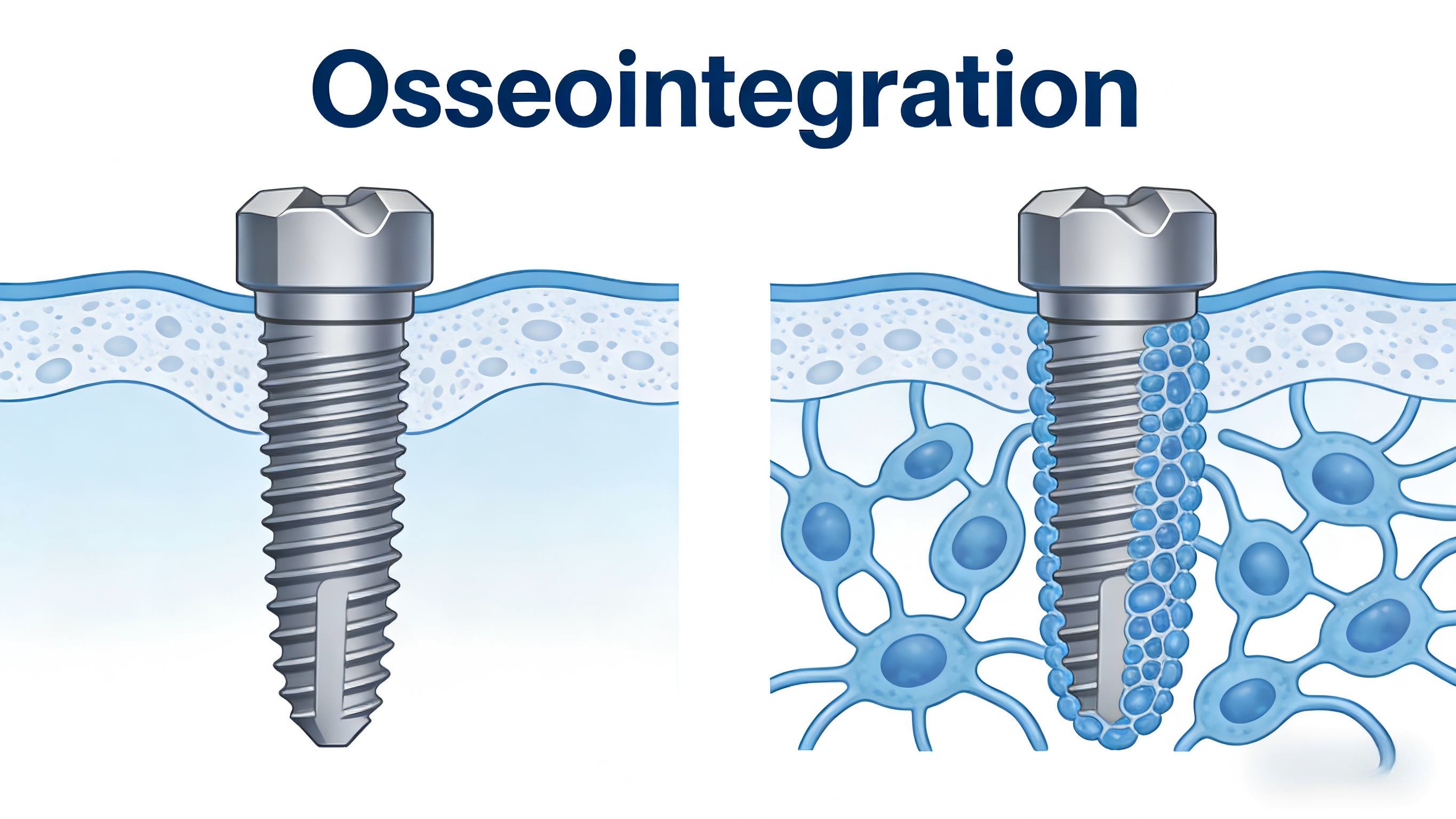
The oral environment is complex and changeable, with saliva, food residues, oral bacteria, and acidic and alkaline substances existing for a long time, which puts high requirements on the corrosion resistance of implant materials. The corrosion resistance of titanium materials is far superior to traditional metals such as stainless steel and cobalt-chromium alloys. The oxide layer on its surface can effectively resist the erosion of various corrosive media in the oral cavity. After long-term implantation, it will not rust, precipitate harmful substances, or cause material aging and strength reduction due to corrosion, ensuring the long-term safety and stability of the implant.
Dental implants need to bear the mechanical load of daily chewing, and at the same time, avoid excessive stress stimulation to the surrounding alveolar bone. The mechanical properties of titanium materials are just suitable for the needs of oral implantation: it has high strength and low density, which can not only ensure that the implant does not deform or break during chewing, but also reduce the "stress shielding" phenomenon through a reasonable elastic modulus (closer to the elastic modulus of human alveolar bone)—that is, avoid the implant bearing excessive mechanical load, allowing the alveolar bone to obtain reasonable physiological stimulation, thereby maintaining the health of the alveolar bone and extending the service life of the implant.
Modern dental implants have extremely high requirements for processing accuracy and surface treatment technology. Titanium materials have good processing plasticity, which is easy for precision turning, grinding, and shaping, and can meet the personalized needs of different implantation scenarios (such as immediate implantation and implantation with insufficient bone volume) for the shape and specification of implants. At the same time, the surface of titanium materials can be adapted to various surface treatment technologies such as SLA (Sandblasted, Large-grit, Acid-etched) and RBM (Resorbable Blast Media), which further improves the speed and success rate of osseointegration and provides more powerful technical support for clinical implantation.
In the field of dental implants, titanium materials are mainly divided into two categories: Commercially Pure Titanium (CP Ti) and Titanium Alloys (the most commonly used is Ti-6Al-4V, i.e., titanium-aluminum-vanadium alloy). There are obvious differences in composition and physical and chemical properties between the two, and their application scenarios also have their own focuses. They are not "the more expensive the better", but need to be reasonably selected according to clinical needs, patients' bone conditions and other factors.
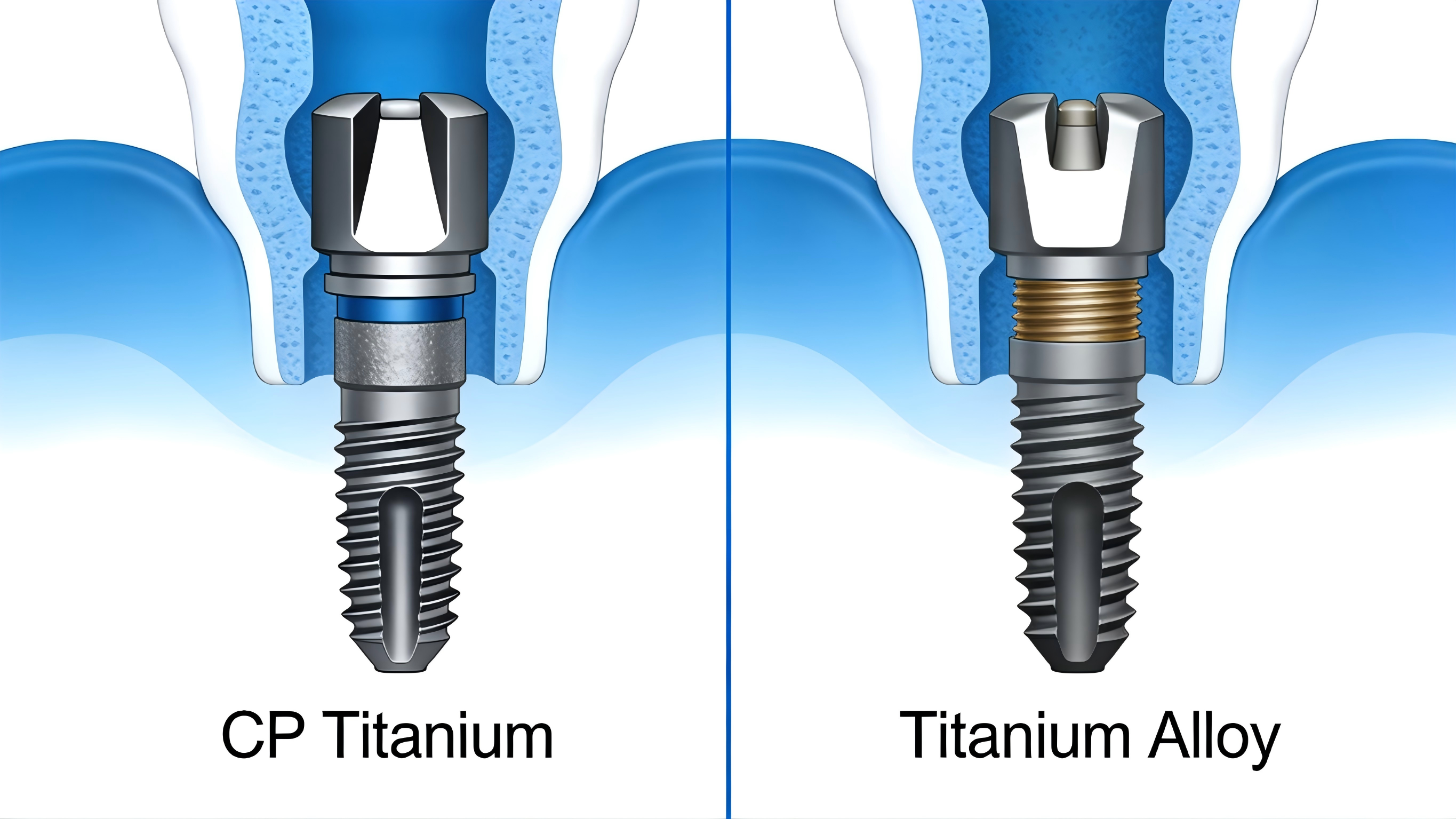
The purity of commercially pure titanium is ≥99%. According to the difference in purity and oxygen content, it can be divided into four grades from 1 to 4. Among them, grade 3 and grade 4 pure titanium are the preferred materials for dental implants due to their moderate strength and better biocompatibility. Its core characteristics and advantages are:
No alloy elements added, the oxide layer is more stable, the risk of rejection is extremely low, especially suitable for patients with poor bone conditions and sensitive constitutions, and also the first choice for long-term implantation scenarios;
Closer to the elastic modulus of human alveolar bone, the stress shielding effect is weaker, which can better protect the alveolar bone, reduce marginal bone resorption, and have better long-term stability;
After decades of clinical verification, the 10-year survival rate of pure titanium implants can reach more than 95%, and the survival rate of some high-quality products even exceeds 98%, with mature technology and controllable risks;
No risk of alloy element precipitation, not easy to appear material aging after long-term implantation, suitable for various oral environments, and applicable to a wider range of people.
At present, the main body of root-shaped implants of mainstream high-end implant brands in the world all take pure titanium as the core material, which shows its core position in the field of dental implantation.
Titanium alloy is made by adding alloy elements such as aluminum and vanadium to pure titanium. Its core advantage is higher strength than pure titanium (the tensile strength is about 40% higher than pure titanium), and the elastic modulus is also higher. It is widely used in orthopedic implants (such as artificial joints), but it is not the mainstream choice in dental implants. Its characteristics and applicable scenarios are as follows:
Suitable for special structural components with extreme requirements on mechanical strength, such as implant abutments, healing caps and other auxiliary accessories, rather than the main body of root-shaped implants;
Alloy elements such as aluminum and vanadium may cause slight irritation to some sensitive people, and the biosafety of long-term implantation is not as stable as pure titanium;
Only suitable for special cases with sufficient bone volume, extremely large chewing load, and special requirements on implant strength, not the first choice for conventional implants;
In recent years, new titanium alloys such as titanium-zirconium alloy (such as materials containing 15% zirconium and 85% titanium) have been gradually applied to high-end implants, balancing strength and biocompatibility, but the price is relatively high and it has not yet become the industry mainstream.
Combined with clinical application experience and material characteristics, for dentists, distributors and purchasers, the selection logic can be summarized into 3 points, balancing practicality and safety:
1. For conventional implantation scenarios, prioritize commercially pure titanium implants: Whether it is single, multiple implants, or conventional immediate implantation, the biocompatibility, long-term stability and wide applicability of pure titanium implants are better than titanium alloys, making them the clinical first choice;
2. Titanium alloys can be used for special accessories: For auxiliary accessories such as implant abutments and transfer rods, titanium alloys can be selected according to mechanical needs, balancing strength and practicality;
3. Prioritize material standards and quality control: Whether choosing pure titanium or titanium alloy, it must meet the ISO 13485 medical-grade material standard, and pass international certifications such as CE and FDA. At the same time, pay attention to the material purity, processing accuracy and quality control system of the manufacturer—the quality of the material itself is the core factor determining the long-term success rate of the implant, not the material type itself.
As a professional dental implant manufacturer, Re-tech has always focused on the research and development and production of titanium material implants with "material safety, controllable precision and clinical adaptability". We insist on using medical-grade grade 3 and grade 4 pure titanium raw materials to control material purity and safety from the source and prevent impurities from mixing in; through precision processing technology, we ensure the dimensional accuracy and surface smoothness of implants, adapt to various surface treatment processes, and further improve the speed of osseointegration; at the same time, all products have passed international certifications such as ISO 13485 and CE, and have undergone strict quality inspection to ensure that each implant can meet the needs of long-term clinical stability.
Whether it is conventional pure titanium implants or titanium alloy auxiliary accessories required for special scenarios, Re-tech can provide one-stop supply solutions to meet the diverse needs of dentists and distributors. To learn more about the product details, specifications and cooperation policies of Re-tech titanium material implants, you can visit our official website: https://www.retechdental.com/, to get professional consultation and support.